
 Contacto
 Como comprar
Entrega
Guia de compras
 Inglês
 36 b
36 b
 Novo
Novo
Até 30 dias para devoluções

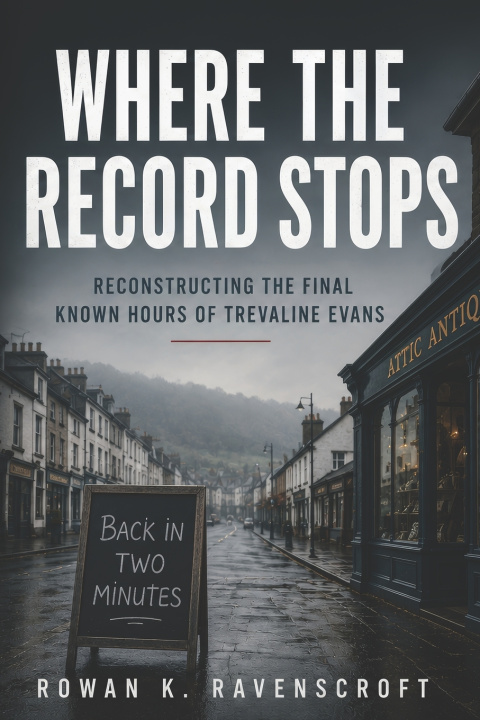
A two-minute promise. A missing woman. A timeline that does not end where the familiar story says it does.
On Saturday, 16 June 1990, fifty-two-year-old antiques dealer Trevaline Evans placed a handwritten notice at Attic Antiques in Llangollen saying she would be back in two minutes. Her handbag, keys, jacket, and car remained behind. The scene suggested a brief interruption-but the public chronology places her alive elsewhere in town after the notice, including a fruit purchase around one o'clock and a reported sighting near her Market Street home at approximately 2:30 p.m.
Where the Record Stops reconstructs those final known hours and asks a more precise question than the familiar story of the note allows: when did an ordinary Saturday become a permanent disappearance?
Drawing on publicly available records, official documents, court materials, archival reporting, published interviews, and the surviving witness chronology, Rowan K. Ravenscroft separates confirmed facts from testimony, official actions, disputed claims, inference, and speculation. The book follows Trevaline's morning at the shop, the notice on the door, the unidentified man later represented in an artist's impression, the fruit purchase, the disputed possibility that she returned to Attic Antiques, and the final reliable movement through Llangollen.
The investigation then turns to what the shop preserved-and what it could not prove. Personal belongings, a parked car, and the absence of a reported struggle suggest that Trevaline expected to return, but they do not identify an offender or establish a crime scene. The witness chain grows less certain as the afternoon progresses, leaving no reliable public account of a vehicle, destination, private meeting, accident site, or route out of town.
The book also examines the original search, the 2001 reinvestigation, later searches and public claims, and the evidentiary limits surrounding persons of interest and proposed suspects. Competing explanations are tested under the same standard: an encounter with someone familiar, an unknown visitor using a credible purpose, accident, voluntary departure, or foul play. No theory is treated as proof merely because it is official, dramatic, familiar, or often repeated.
Written with restraint and respect for Trevaline Evans and her family, this British true crime investigation focuses on timeline, witness reliability, missing evidence, investigative procedure, and the difference between probability and legal certainty. It does not manufacture a solution or identify a responsible person where the released record cannot support one.
For readers drawn to British historical true crime, missing-person cold cases, Welsh crime history, unsolved disappearances, and evidence-led investigative nonfiction, this book offers a careful path through what is known, what remains disputed, and the exact point where the record stops.


Sobre o livro
Inglês

Ofereça este livro hoje
É fácil
1 Adicione ao carrinho e escolha Entregar como presente ao finalizar a compra 2 Receberá um vale 3 O livro chegará ao endereço do destinatárioOlá! Sou o Libroamiko, o seu conselheiro de livros.
Como posso ajudar?