
 Contacto
 Como comprar
Entrega
Guia de compras
 Inglês
 38 b
38 b
Até 30 dias para devoluções
Os clientes também compraram












 /
/
 Capa mole
 26.45
€
26.45
€

 /
Capa mole
43.83
€
/
Capa mole
43.83
€




 /
Capa mole
74.33
€
/
Capa mole
74.33
€



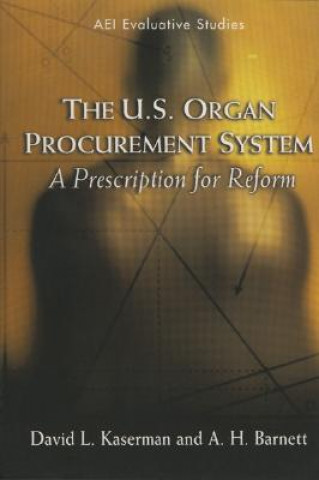
The organ procurement system in the United States has failed patients awaiting transplants, as evidenced by years-long waiting lists, with many patients declining in health or dying before a suitable organ donor is found. The cadaveric organ shortage can be remedied by allowing for organ purchases and sales, to encourage families of the deceased to donate the organs. This monograph is part of AEI's Evaluative Studies Series. The series aims to enhance understanding of government programs and to prompt continual review of their performance. David L. Kaserman is the Torchmark Professor and chairman of the Department of Economics at Auburn University. A. H. Barnett is a professor in, as well as the chairman of, the Department of Economics, International Studies, and Public Administration at the American University of Sharjah in the United Arab Emirates. A summary of the book follows. The first successful human organ transplant in the United States was performed on December 23, 1954, when a kidney was transplanted from a living donor who was an identical twin of the recipient. Since then, the ability to use organ transplants to save the lives and improve the health of thousands of patients suffering from kidney, heart, liver, and other organ failures has improved dramatically. New immunosuppressive drugs and advanced surgical techniques have allowed the successful use of cadaveric donor organs and, thereby, expanded the set of organs for which transplantation is a viable treatment. As a result, the number of organ transplants performed in this country has now grown to approximately 22,000 each year. Despite the tremendous successes that have been achieved, transplantation technology has failed to realize its full promise because of a chronic shortage of cadaveric organs that are made available for that use. The sad fact is that every year for the past three decades the number of cadaveric organs supplied has fallen well short of the number demanded. As a consequence, many patients are denied timely access to this life-saving treatment modality. Those who are deemed medically suitable candidates for transplantation are placed on organ waiting lists, where they often remain for one or more years before an acceptable organ becomes available. While they wait, these patients' health declines, making successful treatment increasingly problematic. Indeed, many of them die before a suitable donor organ is found. As of June 25, 2001, more than 77,000 patients were waiting for an organ transplant. Approximately 7,000 patients died in the preceding year as still more were added to the lists. And as the shortage continues, the length of the lists grows, waiting times increase, and the death toll rises. Importantly, the cadaveric organ shortage is not attributable to an inadequate number of potential organ donors. Of the 2 million or so deaths that occur in the United States each year, estimates indicate that somewhere between 13,000 and 29,000 occur under circumstances that would allow the organs of the deceased to be transplanted. Of these, only 5,843 (or 28 percent of the midrange of the estimates of the number of potential donors) yielded organ donations in 1999. Given the number of potential donors, then, organ collections could easily double or perhaps even triple without exhausting the existing potential supply. Thus, the organ shortage is the product of an ill-conceived public policy that fails to achieve higher collection rates from the available pool of donors. That policy, often referred to as the "altruistic system" of organ procurement, operates (as this name implies) entirely on the basis of unpaid donors. In the typical situation, the families of recently deceased accident or stroke victims who have been declared brain dead are asked for permission to remove the organs of the deceased for use in transplantations. Under the National Organ Transplant Act of 1984, any payment or other form of compensation to encourage the family to donate the organs is strictly proscribed by federal law. As a result, while the suppliers of all other inputs used in a transplant operation are paid market-determined prices, the parties who hold the key that makes transplantation possible cannot be paid. History of the Transplant System Notably, this system has evolved more by historical accident than conscious design. It grew out of a public policy that was intended for use with living, related kidney donors only. Because the earliest transplants were performed exclusively with kidneys donated by the recipients' living relatives, all organ transplant candidates brought the necessary donor with them when they checked into the hospital. If there was no acceptable living donor, there could be no transplant operation. As a result, there were no waiting lists and no apparent shortage. Moreover, under the living related donor system, there was no obvious need for any payment to encourage donor cooperation. The affection associated with the kinship between the donor and recipient was generally thought to be sufficient to motivate the requisite organ supply. And, where it was not, any necessary payment (or coercion) between family members could easily be arranged without resorting to the sort of middlemen generally required for market exchange. Such intrafamily cajoling by emotional pressure or outright payment also remained out of sight of the transplant centers and attending physicians. Therefore, a system of "altruistic" supply seemed to make sense in this setting, and reliance upon such a system did not seriously impede the use of this emerging medical technology. Indeed, it seemed to work quite well. That situation gradually changed, however, as new drugs began to allow the use of cadaveric donor organs and transplant success rates improved. Apparently, sometime during the 1970s, organ waiting lists began to arise as transplant candidates formed queues for needed cadaveric organs. The existing organ procurement system, however, was never altered to meet the needs of the greatly expanded pool of potential recipients created by the new technological opportunities. While some minor modifications have been implemented and considerable sums spent to educate the public regarding the virtues of organ donation, the basic system of complete reliance upon altruism to motivate supply has not changed. As a result, we have come to the current tragic situation in which thousands of patients die each year for lack of a suitable donor organ. These deaths have sparked considerable debate about how best to reform the U.S. organ procurement system to increase cadaveric donations. That debate, in turn, is reflected in a large and growing literature in which a variety of alternative policy proposals have been advanced. These proposals are surveyed in Chapter 3 of this monograph. While some authors have argued for continued reliance upon the current system with, perhaps, an appeal for increased educational expenditures, most now recognize that more fundamental policy change is required. The five most common proposals that have appeared in the literature are: (1) presumed consent, (2) conscription, (3) required request, (4) compensation, and (5) cadaveric organ markets. The first three of these proposals have, to varying degrees, been implemented either in the United States or abroad. In Chapter 3, we describe how each of these policies operates. We then demonstrate that, under reasonable assumptions regarding cadaveric organ supply and demand curves, the proposal to allow cadaveric organ markets to form clearly dominates all other policy options on social welfare grounds. Indeed, the organ market proposal appears to be the only alternative likely to eliminate the organ shortage entirely. Moreover, we estimate that, relative to the current system, creation of a market for procurement of cadaveric kidneys alone would, conservatively estimated, increase social welfare by over USD 300 million per year. Expanding the market system of procurement to other solid organs, then, would be likely to expand these welfare gains to well over USD 1 billion per year. And these welfare gains would be accompanied by several thousand lives saved annually. Despite the likelihood of such superior performance, however, the organ market proposal is not ubiquitously supported by those writing in this area. Both ethical and economic objections have been raised against the use of this most promising policy option. Upon inspection, however, these objections are found to be attributable, to a large degree, to: (1) some rather dubious ethical positions that have, in fact, been shown to be either logically weak or outright specious; (2) some fundamental misconceptions about how markets in general and organ markets in particular might operate in practice; and (3) several implicit (and empirically unlikely) assumptions regarding underlying structural parameters of cadaveric organ supply and demand curves. Chapter 4 addresses the first two sources of opposition, while Chapter 6 attempts to shed some light on the third. Importantly, we demonstrate in these chapters that none of the objections that have been raised in the literature to date is supported by either straightforward economic theory or empirical evidence. A dispassionate, objective analysis of the relevant arguments reveals no sound basis for rejecting the cadaveric organ market proposal. That is not to say, however, that sound economic reasons do not exist for particular interest groups to oppose this policy option. As with any policy change, there are parties likely to win and parties likely to lose from the formation of organ markets and resolution of the shortage. Chapter 5 focuses on the possibility that suppliers of transplant-related services - including, among other things, UNOS (an organization that maintains the nation's organ transplant waiting lists), organ procurement organizations, and transplant centers - could, in theory, suffer a decline in profits or a reduction in (or elimination of) the demand for their services if the organ market proposal were adopted. In addition, other parties providing substitutable services, such as dialysis clinics, could experience financial losses as well. While the economic stakes that a group holds in the outcome of this policy debate are not necessarily determinative of the positions adopted, they at least tend to temper each party's receptiveness to the options presented and the arguments used to support them. Consequently, while the case for adoption of the cadaveric organ market proposed is compelling, one should not expect to observe ubiquitous support for that proposal, particularly among suppliers of transplant services and organizations responsible for managing the shortage. The Case for Change The economic analysis and empirical evidence presented in this monograph support the following significant conclusions: 1. The shortage of cadaveric organs for transplantation has persisted for more than three decades. It is large, growing, and responsible for at least several thousand deaths each year. 2. The organ shortage is not caused by an insufficient number of potentially transplantable cadaveric organs. Rather, it is the direct result of a public policy that proscribes organ purchases and sales. 3. Economic theory strongly suggests that this shortage can be resolved by changing that policy to allow cadaveric organs markets to form. Such markets would permit cadaveric organ prices to rise and fall as necessary to equilibrate supply and demand, thereby eliminating the shortage. The social welfare gains achievable through implementation of the organ market proposal appear to be quite substantial, probably exceeding USD 1 billion per year. 4. Ethical objections to cadaveric organ markets appear to be either logically specious or generally unconvincing. Indeed, the alleged moral superiority of any policy that leads to unnecessary deaths along with higher expenditures must be viewed as inherently suspect. It seems, to us, indefensible to argue that one group of people should be denied lifesaving transplants simply because another group (who neither supplies nor demands cadaveric organs) prefers altruistic supply over market exchange. 5. Initial empirical evidence (though limited) suggests that adoption of organ markets would completely resolve the shortage at surprisingly low equilibrium prices. Our data suggest that payments on the order of USD 1,000 per donor would encourage an increase in the number of donors that would be sufficient to clear the market. These data also suggest that the alleged public opposition to such markets has been grossly exaggerated. It appears that it is the medical community, not the public, that is opposed to organ markets. We believe that these findings conclusively demonstrate the desirability, on social welfare grounds, of repealing the ban on cadaveric organ purchases contained in the National Organ Transplant Act of 1984. That ban has caused the unnecessary deaths of tens of thousands of patients and prolonged the suffering of many thousands more. And, ironically, it has done this while actually increasing federal and state expenditures on the affected programs. Thus, our current cadaveric organ procurement policy simultaneously causes unnecessary deaths and increased costs. And all of this is done for the high moral purpose of preventing the families of recently deceased accident and stroke victims from receiving any payment for their agreement to allow removal of their loved ones' organs.


Sobre o livro
Inglês

Ofereça este livro hoje
É fácil
1 Adicione ao carrinho e escolha Entregar como presente ao finalizar a compra 2 Receberá um vale 3 O livro chegará ao endereço do destinatárioTambém pode estar interessado em




 /
Capa mole
12.31
€
/
Capa mole
12.31
€

 /
Capa mole
15.75
€
/
Capa mole
15.75
€




 /
Capa mole
108.37
€
/
Capa mole
108.37
€













Olá! Sou o Libroamiko, o seu conselheiro de livros.
Como posso ajudar?