
 Contacto
 Como comprar

Entrega
Guia de compras
 Inglês
 346 b
 Em breve
 Novo
Até 30 dias para devoluções

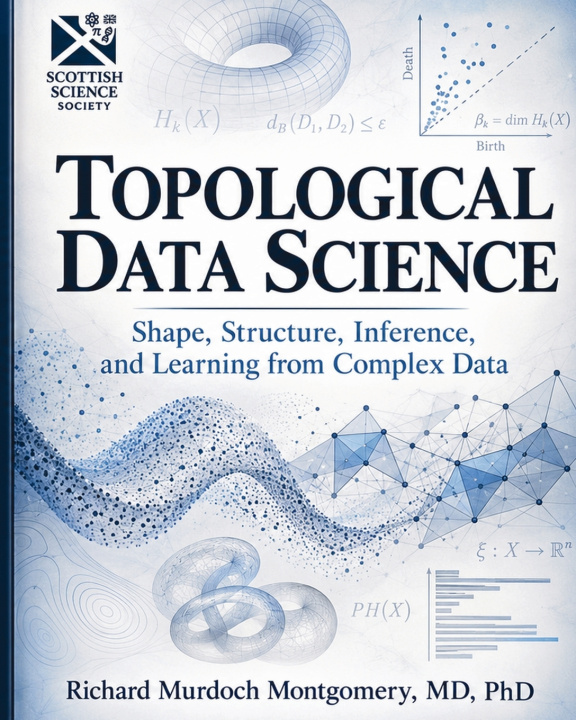
Four questions govern the reading of every chapter. What mathematical object represents the data? Which transformations or perturbations should leave the answer unchanged? Which algorithm computes the declared object, with what approximation and resource cost? Which inferential statement is warranted by the sampling design and uncertainty? The questions recur because difficult disciplines are not mastered by encountering principles once; they are mastered when the same principles survive increasingly inconvenient examples. The first route through the book is linear. It is recommended for readers building the subject from foundations. A second route begins with Chapters 23-26 on persistence, then returns to Chapters 10-19 for the combinatorial and algebraic machinery. A third route begins with an application in Parts XI-XIII and follows every referenced dependency. None of these routes should omit Chapters 28-31 or 49-50, for a computation becomes a scientific result only when uncertainty, validation, and failure modes have been admitted to the room. Notation is conventional but explicit. Sets appear in uppercase letters; observations and vectors generally in lowercase bold or indexed form; functions name their domain and codomain; complexes, chain groups, modules, and measures are introduced before use. Equation numbers are local to chapters or appendices. Figures and tables are numbered within the same divisions. A symbol table follows this introduction, but it is a map, not a substitute for the derivations in the text. Examples progress from synthetic controls to serious datasets. Synthetic examples reveal what a method is capable of seeing because their structure is known by construction. Real examples reveal what the method must negotiate: measurement error, missingness, confounding, dependence, computational limits, and rival interpretations. The transition matters. A method that finds the circle deliberately drawn for it has passed a unit test, not acquired scientific judgement. You are invited to read with a pencil, whether literal or electronic. Before a definition, ask what it ought to preserve. Before a theorem, search for the assumption that prevents the obvious counterexample. Before trusting a diagram, imagine changing the metric, sampling density, coefficient field, or filtration. Before interpreting a feature, ask what non-topological baseline could explain the same observation. The book will provide answers, but it will not deprive you of the more valuable moment before the answer, when the structure of the question becomes visible.


Sobre o livro
Inglês

Ofereça este livro hoje
É fácil
1 Adicione ao carrinho e escolha Entregar como presente ao finalizar a compra 2 Receberá um vale 3 O livro chegará ao endereço do destinatárioOlá! Sou o Libroamiko, o seu conselheiro de livros.
Como posso ajudar?