
 Contacto
 Como comprar
Entrega
Guia de compras
 Inglês
 36 b
36 b
 Novo
Novo
Até 30 dias para devoluções

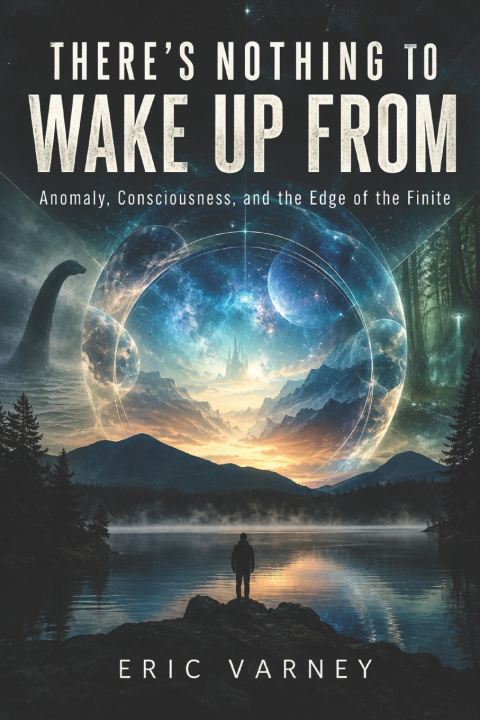
What if the strange things people report are not supernatural-but structural?
For centuries, human beings have described the same kinds of impossible encounters: strange creatures at the edge of civilization, lights that behave as though they are intelligent, places where time seems to move differently, visions that arrive from somewhere they should not, and moments when the familiar world suddenly feels thin.
We have explanations for many of these experiences. Memory fails. Perception deceives us. Animals are misidentified. Folklore evolves. Instruments malfunction. People make mistakes.
But what if, after all the ordinary explanations have been exhausted, something remains?
There's Nothing to Wake Up From proposes a radically different way of asking that question.
The book begins with a problem that appears to have nothing to do with monsters or paranormal experiences: the growing difficulty of scientific discovery. As knowledge accumulates, foundational breakthroughs become increasingly expensive. The frontier retreats. A civilization eventually approaches a Discovery Plateau-a point at which extracting genuinely new information from its existing world becomes harder and harder.
What would an advanced civilization do when it reached that limit? The answer proposed here is extraordinary: build new worlds.
A synthetic multiverse could function as a machine for generating novelty-creating complex environments populated by observers whose decisions, mistakes, cultures, conflicts, discoveries, and experiences produce information that could never have been generated directly.
But such a system would have to be engineered efficiently. It would not necessarily operate as one enormous, perfectly rendered machine. It could operate as an orchestra of specialized systems, coordinated by a higher-level conductor and allocating computational resolution where it is needed.
And if reality were built this way, what would happen when the boundaries between its internal systems began to fail?
That question leads into the book's most controversial idea: Boundary Permeability.
Perhaps the places humans have traditionally called thin places-lakes, rivers, caves, forests, roads, abandoned structures, ritual sites, electromagnetic anomalies, and other thresholds-are not magical doors at all. Perhaps they are locations where the underlying architecture of a finite information system becomes unusually difficult to maintain.
The book follows that possibility through cryptids, lake monsters, folklore, remote viewing, dreams, altered states, time slips, anomalous lights, disappearing vessels, artificial intelligence, consciousness, information theory, and the mathematics of finite systems.
But this is not a book asking you to believe.
It is a book asking whether anomalies can be investigated without either worshipping them or dismissing them.
The framework distinguishes established science from extrapolation, speculation, and outright conjecture. It proposes mathematical formalisms, geographic predictions, experimental protocols, statistical tests, and explicit conditions under which the theory should be rejected. The ordinary explanations are not the enemy; they are the filter.
The central wager is simple:
If reality has an architecture, anomalies should leave signatures.
And if those signatures exist, they should be measurable.
There's Nothing to Wake Up From is an exploration of what reality might look like from the inside when the machinery behind ordinary experience begins to show through-and an invitation to investigate the strange with enough rigor to discover that the answer may be more unsettling than either belief or disbelief.
The framework may be wrong.
That is precisely why it can be tested.


Sobre o livro
Inglês

Ofereça este livro hoje
É fácil
1 Adicione ao carrinho e escolha Entregar como presente ao finalizar a compra 2 Receberá um vale 3 O livro chegará ao endereço do destinatárioOlá! Sou o Libroamiko, o seu conselheiro de livros.
Como posso ajudar?