
 Contacto
 Como comprar
Entrega
Guia de compras
 Inglês
 49 b
49 b
 Em breve
 Novo
Novo
Até 30 dias para devoluções

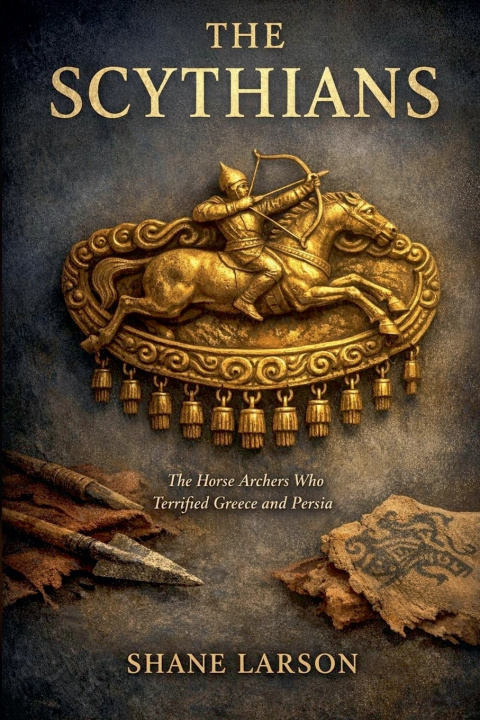
In 513 BC, the largest army in the world marched into the grass north of the Black Sea - and never found anybody to fight.
Darius I of Persia crossed the Danube on a bridge of boats to punish the Scythians. They withdrew a day ahead of him, burning the pasture and stopping the wells, while their cavalry cut up his foragers. When Darius finally demanded that they stand and fight or submit, the answer came back: we have no cities and no fields, so there is nothing here you can threaten - go find the graves of our ancestors if you want a battle. Darius went home. It was the first recorded demonstration of a fact that would hold for two thousand years: a settled empire cannot defeat a steppe power by invading it.
That is the strategic story. The spectacular one came out of the ground. From 1830 onward, the burial mounds of the steppe yielded kilograms of gold, worked in an animal style of astonishing sophistication. And in the Altai mountains, at Pazyryk, ancient tomb robbers let in water that froze and never thawed. Archaeologists lifted out things that survive nowhere else in the ancient world: a knotted wool pile carpet, a complete four-wheeled wagon, saddles with their stuffing intact, horses in antlered headdresses, and human bodies with their tattoos still legible after twenty-four centuries.
Between those two stories runs the rhythm that structures this book. Herodotus reported things nobody believed - kings buried with strangled servants, enemy skulls turned into gilded drinking cups, mourners howling with pleasure in hemp-smoke tents - and claim after claim, the excavations keep confirming him. The report first, then the ground.
What you'll find inside:
- The Danube campaign of 513 BC - the bridge, the burned grass, and the reply that founded steppe warfare
- The great kurgans - Kul-Oba, Solokha, Tolstaya Mogila - and the gold that came out of them
- The frozen tombs of Pazyryk: the carpet, the wagon, the tattooed chieftains
- The royal funeral Herodotus described, and the excavations that matched it chamber by chamber
- The women in armour: the grave counts, the combat injuries, and the evidence behind the Amazon legend
- The doctrine that outlived the people - from Darius to Carrhae to the Mongols
- Three appendices: a gazetteer of the great kurgans, a claim-by-claim audit of Herodotus Book Four, and the steppe toolkit from composite bow to felt tent
This book is for you if:
- You want ancient history built on evidence - what the sources say, what the spade found, and where the two meet
- You are drawn to archaeology at its most vivid: gold, ice, horses, and tattooed skin
- You have wondered where the steppe story begins - before the Huns, before the Mongols
- You like an author who says plainly what is known, what is guessed, and what is legend
Scroll up and meet the king who could not find his enemy.


Sobre o livro
Inglês

Ofereça este livro hoje
É fácil
1 Adicione ao carrinho e escolha Entregar como presente ao finalizar a compra 2 Receberá um vale 3 O livro chegará ao endereço do destinatárioOlá! Sou o Libroamiko, o seu conselheiro de livros.
Como posso ajudar?