
 Contacto
 Como comprar
Entrega
Guia de compras
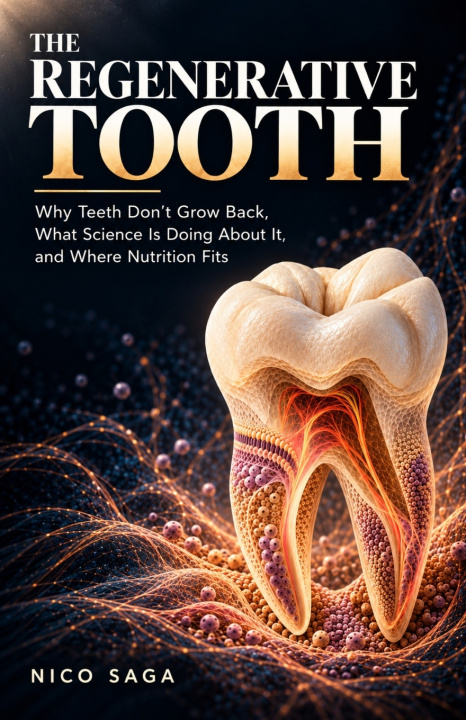
The Regenerative Tooth
Why Teeth Don't Grow Back, What Science Is Doing About It, and Where Nutrition Fits
 Inglês
 41 b
41 b
 Novo
Novo
Até 30 dias para devoluções

Could an adult human jaw ever make another tooth?
A tooth is an organ assembled through a carefully timed developmental sequence. Cells become competent to respond to signals, epithelial and mesenchymal tissues exchange instructions, matrices are produced and organized, mineral is deposited, and the finished structure establishes the blood supply, nerves, attachment, geometry, and durability required for function in the mouth.
The Regenerative Tooth follows that sequence from developmental biology into regenerative medicine. It explains why humans usually stop replacing teeth after the permanent dentition, what Wnt and BMP signalling reveal about tooth formation, and why USAG-1 has become an important target in regeneration research. The book also examines the TRG035 research programme and the scientific questions surrounding its development, while keeping the distinction between experimental progress and clinical proof firmly in view.
Another major challenge appears in enamel. Mature ameloblasts are lost after eruption, leaving the adult tooth with the material those cells produced but without the cells themselves. Research involving human iPSC-derived ameloblast systems, Notch signalling and enamel-like tissue formation offers a way to study this problem. Related work on dental stem cells, engineered tooth germs, scaffolds, lactoferrin and cellular metabolism approaches other parts of the regenerative sequence.
Nutrition has a place in the story at the level of biological support. Calcium, phosphate, vitamin D, vitamin K, dairy proteins, CPP-ACP systems, milk-derived peptides, dietary fats, xylitol, probiotics and the oral environment are examined according to the tissue, mechanism and endpoint studied. The book separates remineralization, repair, tissue regeneration and whole-tooth regeneration so that each finding can be understood at its actual biological scale.
Running through the book is a practical framework for reading evidence. What model was used? What reached the target tissue? What was actually measured? Which developmental transition was affected? What remains before the result can become a functional tooth? These questions make it easier to read research papers, clinical announcements and popular claims without losing sight of what the evidence can support.
For curious general readers, health and science readers, dental professionals, and anyone interested in the future of regenerative medicine, The Regenerative Tooth offers an accessible account of how a familiar human organ is being reconsidered at the frontier of developmental biology.


Sobre o livro
Inglês

Ofereça este livro hoje
É fácil
1 Adicione ao carrinho e escolha Entregar como presente ao finalizar a compra 2 Receberá um vale 3 O livro chegará ao endereço do destinatárioOlá! Sou o Libroamiko, o seu conselheiro de livros.
Como posso ajudar?