
 Contacto
 Como comprar
Entrega
Guia de compras
 Inglês
 58 b
58 b
 Novo
Novo
Até 30 dias para devoluções

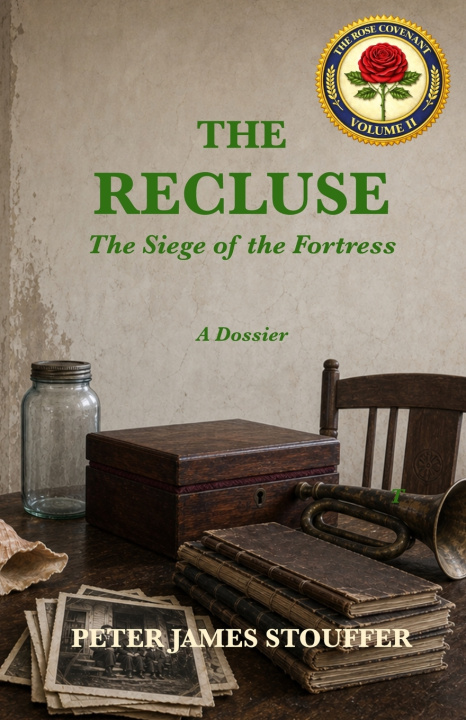
February 1983. Elias Thorne, a young architectural historian from the University of Michigan, arrives at the VanDeusen Fortress on Hensell Road in Rose Township, Michigan - a mid-nineteenth-century Gothic Revival farmhouse that has just cleared foreclosure and is days away from its first sale outside the family in a hundred and thirty years. His assignment is forensic: document the structure before the new owners arrive. He has seven days.
What he finds is a dossier. A kitchen floor worn to an eight-and-three-quarter-inch path by decades of the same body moving through the same morning labor. A mantel clock stopped at October 12 - a date, not a time - its mechanism destroyed, its hands held where they were placed in 1958. A piano with eleven dead hammers, its middle register silenced. A sealed artesian well. A dead chimney flue hiding an oilcloth bundle, a land patent, and ten photographs that have not been opened since 1978.
Behind these facts is Donald VanDeusen, who lived alone in the house for twenty years after his wife died, after his brother left for the city, after he signed an oil lease he came to regard as a sin. The brine blowout ruined the well. He sealed it with copper brazing and spent thirteen years hauling water from the creek. He refused every offer, every development proposal, every accommodation that would have made staying easier. Then a commune moved in, the bank foreclosed, and Donald was sent to Florida. He left nothing in writing. He left everything in the house.
Guided by Samuel Walker - a land surveyor whose grandfather first drove iron pins into this section in 1923 - Elias reconstructs Donald's forty-year reckoning with the land: the penance, the refusals, the artifacts carefully preserved inside the house's frame. A Story Box of heirlooms recovered from a Battle Alley antique dealer. A fossilized colonial coral last seen by a child in 1905. A manuscript hidden in a piano, written by Donald's oldest friend, that turns out to be the record the house has been waiting to deliver.
*The Recluse* operates in the tradition of Steinbeck's Salinas Valley: land as moral medium, matter as the archive that outlasts documents. The novel is built as a genuine dossier - tactile, acoustic, architectural - and its deepest achievement is making each recovered object feel as though it has undergone a long moral apprenticeship before Elias finds it. A hinge's G-sharp cry, wet-glass rings pressed into a piano lid, a brass safety pin holding an uncashed check to a summer kitchen wall: nothing here is arranged for atmosphere. Everything is evidence of how a person chose to live.
Structured as a seven-day investigation that expands into four decades of stewardship, *The Recluse* follows the Fortress through the hands of the Bowens, the Noveks, and finally Sarah and Luke, who strip back ruinous renovations and find the house has survived not because it was protected but because the damage accumulated as overburden above what it hid. The novel's central argument - that endurance is not passivity but a chosen, costly form of love - is made not through statement but through floors, brick, plaster, and the slow work of restoration.
The second volume of *The Rose Covenant*, an eight-volume reverse-chronology series set in Rose Township and Holly, Michigan, *The Recluse* stands fully on its own while establishing the method of the larger sequence: not plot extension, but buried continuity. Later volumes exist inside earlier objects. The Ben East manuscript points toward the next book; an architectural heirloom points toward the one after that. The connections feel like inheritance, not franchise.
For readers of Kent Haruf, Marilynne Robinson, and Wendell Berry - fiction of place that takes seriously what a landscape asks of the people who claim it.


Sobre o livro
Inglês

Ofereça este livro hoje
É fácil
1 Adicione ao carrinho e escolha Entregar como presente ao finalizar a compra 2 Receberá um vale 3 O livro chegará ao endereço do destinatárioOlá! Sou o Libroamiko, o seu conselheiro de livros.
Como posso ajudar?