
 Contacto
 Como comprar
Entrega
Guia de compras
 Inglês
 49 b
49 b
 Em breve
 Novo
Novo
Até 30 dias para devoluções

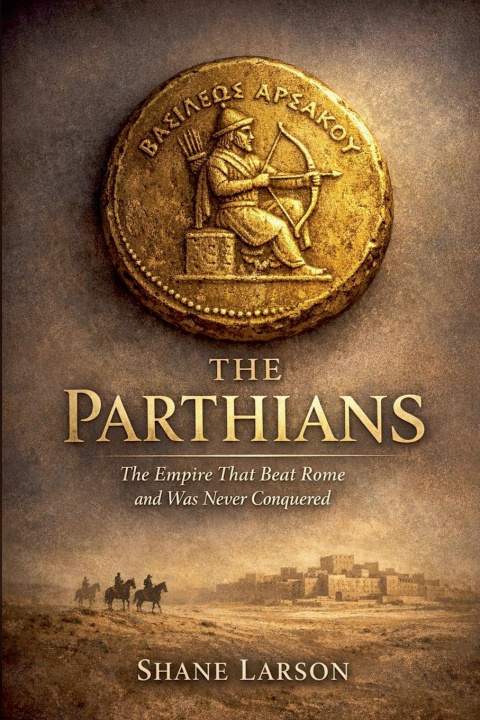
Forty thousand Romans marched into the Mesopotamian desert. By the next nightfall their army had ceased to exist - destroyed by a force a quarter its size that contained no infantry at all.
The Parthian commander at Carrhae did not get lucky. He executed a doctrine: horse archers who refused to close, a camel train of spare arrows so the volleys never stopped, and armoured cataphracts held back for the moment the legions broke formation. Crassus, the richest man in Rome, lost his son, his eagles, and finally his head. Rome spent thirty-three years recovering the standards - and got them back by negotiation, not battle, after which Augustus stamped the event on his coinage because it was the closest thing to a victory over Parthia that Rome could truthfully claim.
For three hundred years the ancient world held two superpowers, and you have only ever been shown one of them. Rome invaded Parthia five times across four centuries. It sacked the Parthian capital three times. It never held a mile. And when the Arsacid empire finally fell, it was not to a Roman army but to a rebellious vassal from Fars - an internal revolt that succeeded in three years where the greatest military machine of antiquity had failed for four hundred. The frontier the two powers contested for nearly three centuries ended the period almost exactly where it began.
This is that empire's story, told at last from its side of the field: a state reconstructed from its enemies' reports, its own coins, a garrison payroll, and two thousand wine-jar receipts. What emerges is not a weaker Persia but something stranger - a federation of great noble houses whose structure explains its tactical brilliance, its chronic civil wars, and its death from the inside, all in one move.
What you'll learn:
- How Carrhae actually worked - the composite bow, the Parthian shot, and the ammunition train that decided the battle
- Why the legion, unbeatable in the west, had no answer to an army that would not stand still
- How a steppe dynasty ruled Iranians, Babylonians, Greeks, and Jews - and struck its coins in Greek for centuries
- Why Armenia, the buffer kingdom neither empire could hold, kept dragging both back to war
- What Trajan's march to the Persian Gulf really accomplished, and why Hadrian handed it all back
- How a Roman "victory" carried the Antonine Plague home along the very roads it had opened
- How the empire Rome never beat was destroyed from within - then written out of history by its successors
This book is for you if:
- You know Rome's story well and want to see it, for once, from the far bank of the Euphrates
- You want military history that explains why a doctrine worked, not just who won
- You enjoy watching a lost world rebuilt honestly from fragments - coins, potsherds, and hostile witnesses
- You want the honest version - where the evidence is thin, this book says so and shows its working
- You suspect the ancient world was bigger than the bookshelf about it
Two empires fought for three centuries, and only one kept the books. Here is the other half of the story.


Sobre o livro
Inglês

Ofereça este livro hoje
É fácil
1 Adicione ao carrinho e escolha Entregar como presente ao finalizar a compra 2 Receberá um vale 3 O livro chegará ao endereço do destinatárioOlá! Sou o Libroamiko, o seu conselheiro de livros.
Como posso ajudar?