
 Contacto
 Como comprar
Entrega
Guia de compras
The Measure of Desire
 Inglês
 27 b
27 b
 Novo
Novo
Até 30 dias para devoluções

Genre: Historical erotic fiction.
Subgenre: Erotic psychological coming-of-age novel centered on female emancipation, with elements of historical romance, moral drama, and romantic suspense. The story begins in the fall of 1805 and centers on a twenty-six-year-old Elinor Dashwood, already defined by her emotional discipline and a long-established habit of self-denial.
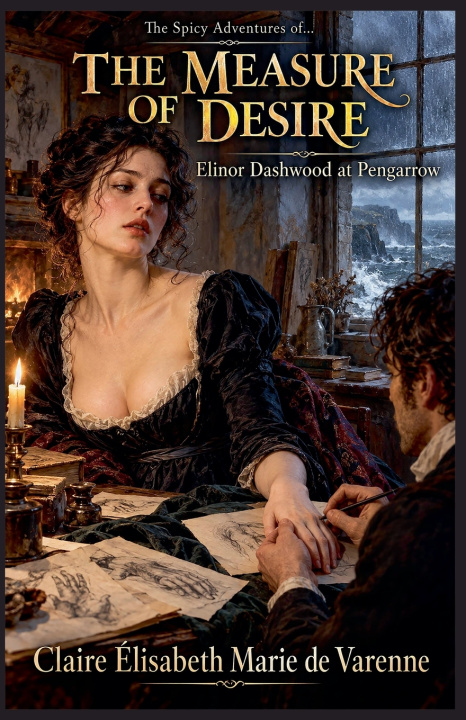
In the fall of 1805, twenty-six-year-old Elinor Dashwood leaves Barton to spend the winter at Pengarrow House, an isolated residence on the Cornish coast, where Lady Honoria Treverren entrusts her with organizing the vast and disorderly library of her late husband. Accustomed to living according to restraint, prudence, and discipline, Elinor regards the work as a useful and manageable interlude. But Pengarrow, with its salt-filmed windows, ceaseless sea, and rooms heavy with memories, slowly begins to undermine the order she has constructed around herself. Among the shelves, Elinor discovers a hidden cabinet containing books and images that no respectable lady should know about. Curiosity soon becomes an intimate confrontation with desires she has always ignored or suppressed. At the same time, she meets Tristan Carew, a solitary painter who lives in a cottage on the cliff and paints the sea even in the rain. His gaze, unconstrained by convention and capable of perceiving what Elinor tries to conceal, both attracts and unsettles her. When Tristan proposes painting a portrait of her hands, a slow intimacy develops between them, built on observation, silences, hesitation, and trust. The library, however, conceals more than a forbidden collection. A drawing that appears inexplicably, a sentence written in the margins of some papers, and certain aspects of Lady Honoria's behavior make Elinor realize that others know the house's secrets. The widow, an intelligent and unconventional woman, becomes a decisive presence in her life: through confidences about her own past and a conception of desire far removed from conventional morality, she encourages Elinor to distinguish what she truly wants from what she has been taught to consider right. As her attraction to Tristan grows, the shadow of a past he is not yet ready to reveal also emerges. The Reverend Aldous Venn, an educated and kind widower, warns Elinor that the painter carries a complicated history with him; shortly afterward, family circumstances arising in Barton force the heroine to question her own future with new urgency. Set against her newly discovered freedom are security, reputation, responsibility toward her mother and Margaret, and the possibility of a socially irreproachable life. With the arrival of winter, Pengarrow thus becomes the setting for a profound transformation. Elinor must do more than choose between people or different forms of love: she must understand whether the reason that has always protected her is truly her most authentic voice or a discipline she has developed to avoid ever taking risks. Amid storms, snow, letters, confessions, and decisions capable of changing the destinies of several people, the novel follows her education in desire and freedom without reducing it to mere transgression. The true conflict becomes the search for a new measure, one in which feeling, the body, responsibility, and autonomy can coexist without any one of them negating the others. In achieving this, the truth of who she is remains the decisive test.


Sobre o livro
Inglês
Categorias

Ofereça este livro hoje
É fácil
1 Adicione ao carrinho e escolha Entregar como presente ao finalizar a compra 2 Receberá um vale 3 O livro chegará ao endereço do destinatárioOlá! Sou o Libroamiko, o seu conselheiro de livros.
Como posso ajudar?