
 Contacto
 Como comprar
Entrega
Guia de compras
 Inglês
 25 b
25 b
 Novo
Novo
Até 30 dias para devoluções

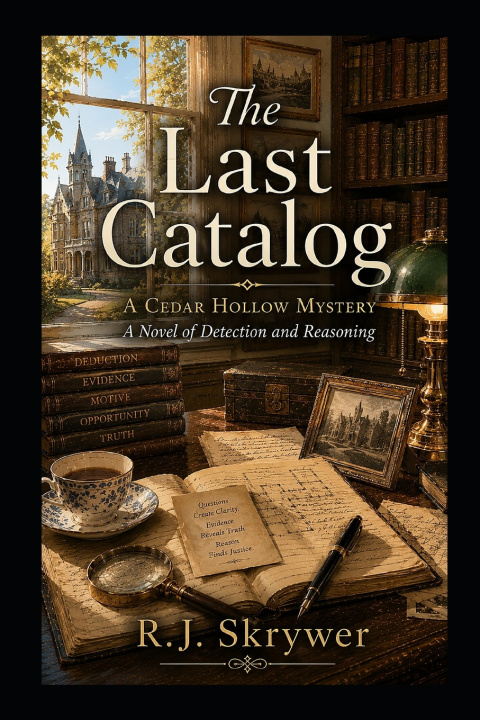
A locked room. A dead bookseller. Two keys accounted for. And a mystery that can only be solved by learning how to think.
When Walter Hensley, the owner of a rare-book shop in the quiet town of Cedar Hollow, is found dead in his locked study, the evidence seems to point to a tragic accident. The windows are sealed. There is no sign of forced entry. His key is still on his body.
But Detective Elena Reyes knows that what seems obvious and what the evidence actually proves are two very different things.
Alongside her fifteen-year-old nephew Mateo, Elena begins examining the clues one by one. A suspicious head wound. A second key. Conflicting alibis. Financial records that don't quite add up. Handwriting that may reveal more than its writer intended. And, eventually, a single letter that could change the entire investigation.
To uncover the truth, Elena and Mateo must do more than collect clues. They must reason.
The Last Catalog: A Cedar Hollow Mystery is a detective novel with a second purpose: it teaches readers how to think more clearly through the mystery itself. As the investigation unfolds, readers encounter three fundamental forms of reasoning, deduction, induction, and abduction, and see how each can uncover the truth, mislead an investigator, or expose an assumption that was never as certain as it appeared.
Each chapter combines an unfolding mystery with The Detective's Reasoning, a clear explanation of the thinking used during the investigation. Discussion questions invite readers to examine the evidence for themselves, while the book's Reasoning Toolkit explores logical thinking, common reasoning errors, and practical ways to evaluate claims in everyday life.
Written for teens, adults, families, classrooms, homeschoolers, and anyone who enjoys mysteries with something more beneath the surface, The Last Catalog turns critical thinking from an abstract school subject into a skill readers can actually practice.
Because the most dangerous mistake isn't reaching the wrong conclusion.
It's never asking whether the conclusion follows from the evidence.
Enter Cedar Hollow. Follow the clues. Question your assumptions.
And see if you can reason your way to the truth.


Sobre o livro
Inglês
Categorias

Ofereça este livro hoje
É fácil
1 Adicione ao carrinho e escolha Entregar como presente ao finalizar a compra 2 Receberá um vale 3 O livro chegará ao endereço do destinatárioOlá! Sou o Libroamiko, o seu conselheiro de livros.
Como posso ajudar?