
 Contacto
 Como comprar

Entrega
Guia de compras
 Inglês
 81 b
 Novo
Até 30 dias para devoluções

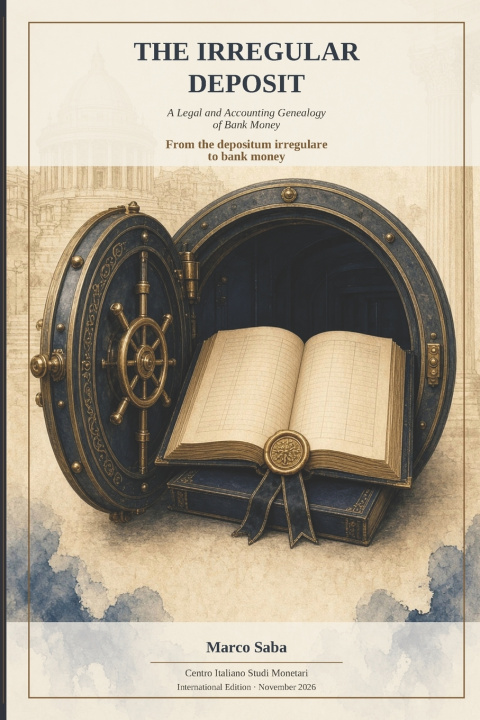
The Irregular Deposit reconstructs how bank money became possible as a legal and accounting fiction.
Almost all money in circulation today consists of bank deposits-accounting entries on the liability side of private banks. Central banks now openly state that deposits are "a liability of the bank, not an asset that could be lent out" (Bank of England, 2014). The economic fact is settled; the legal question that precedes it is not: by what transaction does the sum handed over by the customer become the property of the bank and, at the same time, money?
The monograph answers by tracing the genealogy of the irregular deposit (depositum irregulare) from Roman law and the Hellenistic parakatatheke, through the medieval Gloss, the Italian banks, Salamanca, and the custodial counter-model of the Amsterdam Wisselbank, down to nineteenth- and twentieth-century codifications and their contemporary persistence. The method combines comparative legal history, economic history, and accounting analysis, drawing on primary sources: the Digest, codes, case law, and central-bank documents.
The comparative survey of eight systems-Germany, France, Switzerland, Spain, Italy, Great Britain, the Netherlands, and the United States-identifies a "shielding gradient": eight distinct strategies for masking the transfer of ownership. At one pole stands the German minimal mask (§ 700 BGB and the Dresdner Entwurf of 1866), which expressly reduces the irregular deposit to a loan. France relies on a judge-made screen (assimilation to loan by case law without a statutory text). Switzerland adopts the oblique formula of Art. 481 CO 1881 ("benefit and risk"), remaining silent on ownership. Spain assimilates the mercantile deposit to the loan while the Civil Code retains a custodial residue. Italy reaches radical explicitness: Art. 1834 of the 1942 Civil Code states that the bank "acquires ownership" of the money. Great Britain, with Foley v Hill (1848), treats the banker as a mere debtor without any Romanist fiction. The Netherlands supplies the historical custodial counter-model (Wisselbank of Amsterdam). The United States moves from common-law debt to public regulation (National Bank Acts, FDIC).
The work also reconstructs two institutional paradoxes. In Italy, Art. 1834 was adopted after the 1936 publicisation of the banking system. In Switzerland, the same year that saw the first systematic codification of the irregular deposit (1881) later saw the popular rejection of the Vollgeld (sovereign-money) initiative in 2018. The Italian Court of Cassation, in 2019, still described the nature of the bank deposit as "controversial in legal scholarship."
The result is that bank money is a datable legal-accounting artefact: a contractual fiction that the codifications fixed without ever resolving its cause. The balance-sheet liability is the material proof of the fiction-the point where legal form and accounting entry converge.


Sobre o livro
Inglês

Ofereça este livro hoje
É fácil
1 Adicione ao carrinho e escolha Entregar como presente ao finalizar a compra 2 Receberá um vale 3 O livro chegará ao endereço do destinatárioOlá! Sou o Libroamiko, o seu conselheiro de livros.
Como posso ajudar?