
 Contacto
 Como comprar
Entrega
Guia de compras
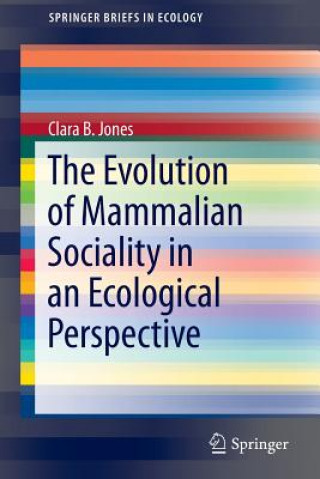
The Evolution of Mammalian Sociality in an Ecological Perspective
 Inglês
 132 b
132 b
Até 30 dias para devoluções
Os clientes também compraram

 /
/
 Capa mole
 25.35
€
25.35
€



 /
Capa mole
38.80
€
/
Capa mole
38.80
€

Evolutionary transitions to sociality within and between mammalian taxa are central to a scientific understanding of sociality as a phenomenon. The Introduction to the proposed brief presents the Class as the most ecologically dominant terrestrial vertebrate fauna. Section 2 details the monograph s application of r large and r small, situating these notations in the context of Hamilton s kin selection paradigm describing decisions (Fig. 1.1) to allocate reproductive effort as direct (individual) reproduction, on the one hand, and indirect reproduction via helping kin s reproductive interests, on the other. This section introduces the assumption that some mammals have managed intraspecific and interspecific competition by adopting one or more social strategies determined by ecological as well as other factors (e.g., abiotic factors such as soil gradients, value of information gained). A summary of current and proposed drivers of mammalian sociality is presented in sections 3 and 4, including a critique of the latter model. Section 5 details levels of organization of a social mammal, including: social genetics, sociogenomics, social neuroscience, and behavior. Varieties of mammalian social structures will be reviewed in Chapters 6 and 7, from solitary to primitive eusocial. The Synthesis and Coda integrate mammalian sociality with literature on attempts by a variety of research programs to unify the field of social biology, from social insects to humans, a project that, in theory, is expressible in energetic terms (see Evans et al. 2011). It is hypothesized that social evolution in the Class has been constrained, in part, because of the stress imposed by endothermy and other metabolic demands (Jones 2009). For these same reasons, however, it is argued that most mammals exhibit capacities to tolerate conspecifics (Ewer 1968), decisions minimizing conditions leading to wasted energy via aggressive neglect .


Sobre o livro
Inglês

Ofereça este livro hoje
É fácil
1 Adicione ao carrinho e escolha Entregar como presente ao finalizar a compra 2 Receberá um vale 3 O livro chegará ao endereço do destinatárioTambém pode estar interessado em



 /
Capa mole
40.71
€
/
Capa mole
40.71
€
Olá! Sou o Libroamiko, o seu conselheiro de livros.
Como posso ajudar?