
 Contacto
 Como comprar
Entrega
Guia de compras
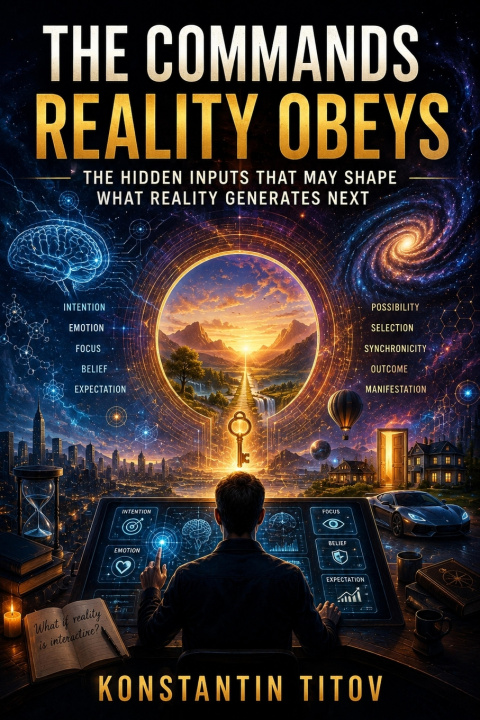
THE COMMANDS REALITY OBEYS
Emotion, Intention, Attention, and the Search for the Hidden Interface of the Universe
 Inglês
 64 b
64 b
 Em breve
 Novo
Novo
Até 30 dias para devoluções

What if reality does not respond to what you want but to what your mind actually communicates?
A light switch can activate an electrical system containing thousands of components. A few lines of code can mobilize servers across the world. A tiny biological signal can initiate an enormous chain of events.
The visible command may be small. The system behind it is not.
Could reality work the same way?
In The Commands Reality Obeys, Konstantin Titov investigates one of the most provocative questions at the boundary of consciousness, psychology, probability, and philosophy:
Could certain states of mind function as inputs into the world around us?
The journey begins with something science already knows: the brain does not passively copy reality. Perception is constructed from incoming information, expectation, memory, attention, and interpretation.
But changing what we perceive is one thing.
Changing what actually happens is another.
From extraordinary coincidences and precise financial events to intention, expectation, emotional intensity, synchronicity, and apparent responses from external systems, Titov develops the concept of a Reality Interface-a hypothetical boundary through which internal states might influence outcomes.
This is not another book promising that positive thoughts magically attract wealth.
Instead, it asks the harder questions.
What separates desire from expectation?
Could emotional intensity act as signal gain?
Does the structure of an internal state matter more than its strength?
Why do some coincidences feel impossibly precise?
How would we distinguish manifestation from probability, selective memory, hidden behavior, or ordinary causation?
And if an unknown effect really existed, how could we prove it?
The book introduces a disciplined framework for investigating extraordinary experiences without either blindly believing them or automatically explaining them away. It explores Reality Syntax, the Lock State, hidden causal pathways, coincidence, selection, and the possibility that compact information can produce enormous consequences when it enters the right system.
The final question is deliberately left open:
Perhaps consciousness changes reality simply by changing perception, decisions, behavior, and action.
Or perhaps something more remains undiscovered.
Before we can understand the machinery, we may first have to discover the controls.


Sobre o livro
Inglês

Ofereça este livro hoje
É fácil
1 Adicione ao carrinho e escolha Entregar como presente ao finalizar a compra 2 Receberá um vale 3 O livro chegará ao endereço do destinatárioOlá! Sou o Libroamiko, o seu conselheiro de livros.
Como posso ajudar?