
 Contacto
 Como comprar
Entrega
Guia de compras
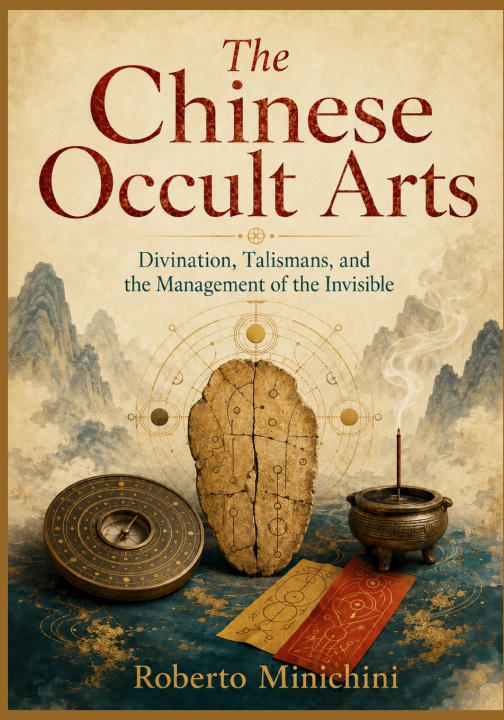
The Chinese Occult Arts
Divination, Talismans, and the Management of the Invisible
 Inglês
 70 b
70 b
 Novo
Novo
Até 30 dias para devoluções

A collectible and gift-worthy volume, presented in a very large format with a durable hardcover.
"The Chinese Occult Arts: Divination, Talismans, and the Management of the Invisible" offers a broad historical exploration of the techniques through which Chinese societies interpreted signs, negotiated unseen powers, protected households, treated illness, selected graves, and sought to influence destiny.
Beginning with the oracle-bone inscriptions of the late Shang dynasty, especially the divinatory archives associated with the reign of King Wu Ding around 1250-1192 BCE, the book follows the transformation of occult knowledge across more than three millennia. It examines the "Yijing," calendrical science, astrology, numerology, dream interpretation, spirit communication, talismans, exorcism, thunder rites, feng shui, medicine, external and internal alchemy, domestic cults, sectarian traditions, and modern forms of spiritual consultation.
Particular attention is given to the political and social environments in which these practices developed. Under the Han dynasty, from 206 BCE to 220 CE, divination, medicine, omen interpretation, and religious healing became increasingly connected with imperial administration. The Yellow Turban uprising of 184 CE demonstrated how therapeutic and prophetic networks could become forces of rebellion. During the Tang dynasty, from 618 to 907, Daoist, Buddhist, medical, and courtly traditions interacted through ritual, translation, healing, and state protection. Song rule, from 960 to 1279, encouraged the growth of printing, celestial bureaucracy, thunder rites, lineage institutions, and increasingly elaborate systems of household and funerary organization.
The volume also investigates the role of tombs and ancestral graves in the accumulation of property and local power, the competition among physicians, priests, mediums, healers, and alchemists, and the participation of women as clients, midwives, ritual experts, spirit-mediums, and guardians of domestic knowledge. Religious movements connected with Maitreya, the White Lotus, the Unborn Mother, spirit writing, and salvation societies are treated as historically distinct traditions rather than as one continuous secret organization. The rebellions of 1351, 1622, 1774, 1796-1804, and 1813 reveal different moments in which prophecy, mutual aid, clandestine organization, and political crisis converged.
The final sections follow the redefinition of occult practices during the fall of the Qing dynasty in 1911, the establishment of the Republic in 1912, the foundation of the People's Republic in 1949, the Cultural Revolution of 1966-1976, and the religious and commercial reopening that began after 1978. Scientific language, psychology, nationalism, state repression, qigong, cultural heritage, digital media, and global spirituality all contributed to the reinvention of traditions once rooted primarily in temples, villages, lineages, and households.
Written for both specialists and general readers, the book combines historical reconstruction with clear explanations of difficult concepts. It presents Chinese occult arts neither as a timeless collection of superstitions nor as an idealized body of secret wisdom, but as changing systems of knowledge shaped by governments, families, markets, religious institutions, political conflicts, and the persistent human need to manage uncertainty.
About the Author
Roberto Minichini is an Italian writer, poet, essayist, esotericist, and scholar of the history of religions. Born in Mainz, Germany, in 1973 to an Italian father and a Croatian mother, he has lived in Gorizia, Italy, since 2000. His work explores religious history, esotericism, comparative spirituality, literature, symbolism, political theology, divination, minority traditions, and the relationship between sacred knowledge and social authority.


Sobre o livro
Inglês
