
 Contacto
 Como comprar
Entrega
Guia de compras
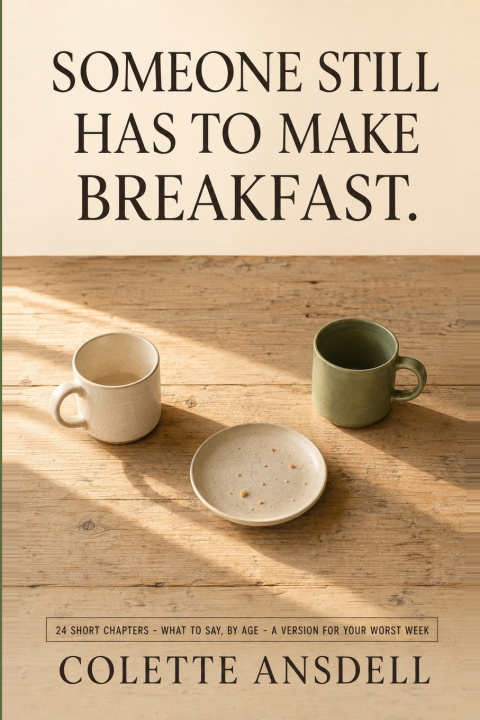
Someone Still Has to Make Breakfast
 Inglês
 118 b
118 b
 Novo
Novo
Até 30 dias para devoluções

The worst thing that has ever happened to you happened on a Tuesday, and on Wednesday morning somebody still needed a packed lunch.
That is the situation this book is about. Not the marriage - the household. What to say at half past seven when a child asks why you have been crying. What a five-year-old does with an atmosphere nobody has named. How to get through a bedtime when you have nothing left. What happens in month four, when the crisis is over and everything is still wrong.
It will not tell you whether to stay or leave. That decision is not a stranger's to make, and it is worth knowing on the first page rather than waiting three hundred for a verdict that is never coming.
THE ONE THING THIS BOOK IS BUILT ON
Children in a house with an unexplained atmosphere do not conclude that the adults have a problem. They conclude that they have done something - because their own behaviour is the part of the world they know they can affect.
So they go back over the week and find something. Then they wait, quietly, for the consequence.
Almost everything in these pages follows from that.
TWENTY-FOUR SHORT CHAPTERS, ALL BUILT THE SAME WAY
Every chapter contains:
- A few pages of plain explanation of what is happening and why
- AT THE KITCHEN TABLE - one ordinary situation, and what it actually needs
- WORDS THAT WORK - sentences you can say out loud, ready made
- WORDS THAT MAKE IT WORSE - and the reason each one lands badly
- BY AGE - three to six, seven to eleven, twelve and over, because the same moment needs three different handlings
- ON A BAD WEEK - the reduced version, for when the full one is not available
- THE SMALLEST VERSION OF THIS - one thing, if you can only do one
- FOR YOU, NOT FOR THEM - a page about the adult
- Space to write, if writing helps
INSIDE
Mornings. The school run and the school gate. Dinner and the hour before it. Bedtime. Weekends, which are much longer than you remember. Rows, doors, and what carries through a house. When they ask a direct question. Not making a child a confidant. Not asking them to choose. What to do with your own anger in front of them. The child who becomes helpful - and why that one needs more attention, not less. The child who becomes difficult. Months rather than weeks: what slips and what to watch. And what you want them to be able to say about all this in twenty years.
Plus, at the back: what to do when there are two houses now, when the children adore the person who did this, and when you are doing every bit of it with nobody to talk to.
WHAT IT WILL NOT DO
No statistics about how children fare. No case studies - nobody in these pages is a real child. No labels for your partner. And no legal or financial guidance of any kind: nothing about custody, contact, housing, or money, because those belong to a qualified professional in your own country, and the book says so and points you there instead.
A NOTE ON THE AUTHOR
Colette Ansdell is a writer, not a therapist, a physician, a social worker, or a lawyer, and the book says so plainly rather than implying otherwise.
Nobody is marking you. You are absorbing an enormous personal injury while continuing to be the reliable adult in somebody else's childhood, and the fact that you are doing it badly on some days is not a finding about your character.


Sobre o livro
Inglês
Categorias

Ofereça este livro hoje
É fácil
1 Adicione ao carrinho e escolha Entregar como presente ao finalizar a compra 2 Receberá um vale 3 O livro chegará ao endereço do destinatárioOlá! Sou o Libroamiko, o seu conselheiro de livros.
Como posso ajudar?