
Faça parte de uma comunidade de amantes de livros de todo o mundo e tenha acesso a uma série de benefícios.
Crie uma conta gratuitamente
Correio DHL 7.99 €
Correio DPD 4.49 €
Ponto DPD 3.99 €
Correio GLS 5.49 €
Correio MRW 5.49 €
Ponto GLS 4.49 €
 Contacto
 Como comprar
Ajuda
Entrega
Correio DHL 7.99 €
Correio DPD 4.49 €
Ponto DPD 3.99 €
Correio GLS 5.49 €
Correio MRW 5.49 €
Ponto GLS 4.49 €
Guia de compras
A minha conta
▸
Vazio :-(
0
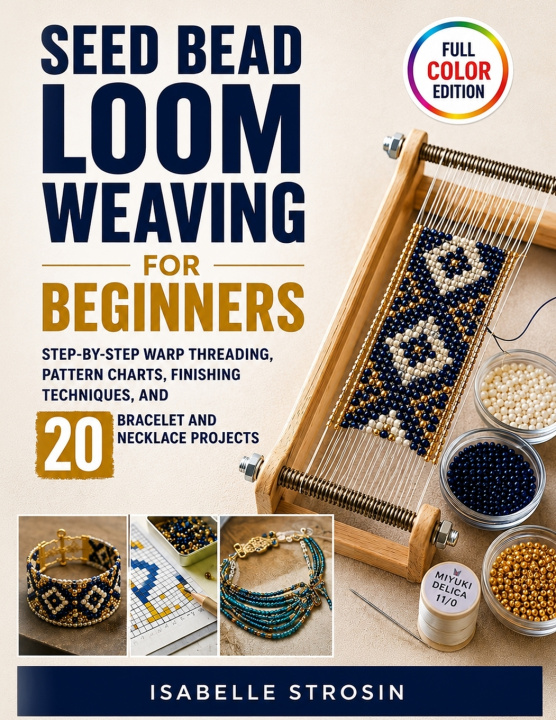
Seed Bead Loom Weaving for Beginners
Step-by-Step Warp Threading, Pattern Charts, Finishing Techniques, and 20 Bracelet and Necklace Projects
Língua
 Inglês
Inglês
Livro
Capa mole
The warp is either set correctly or it isn't, and almost no beginner resource teaches you how to tel...
Descrição completa
Código Libristo: 53011159
?
 56 b
56 b
 Novo
Novo
56 b
Novo
23.00
€
Armazenamento externo
Envio em 14-21 dias
Até 30 dias para devoluções
Os clientes também compraram




The warp is either set correctly or it isn't, and almost no beginner resource teaches you how to tell the difference.
The mechanics are not the problem. What stops people, reliably, is warp setup, tension management, and finishing. Most guides give each one a paragraph. The result is a panel with twenty hanging thread tails, edges that have been narrowing since row twelve, and no plan for the rest. The loom goes back in its box.
Warp, Weft, and Finishing: What Changes
- Set a warp with even tension across all threads before picking up the first bead
- Read any pattern chart, row by row, through geometric, floral, and pictorial designs
- Execute the return pass so every bead locks flat above the warp every time
- Choose the finishing method that fits the piece rather than one method for everything
- Attach clasps and end bars correctly so they hold through regular wear
- Diagnose draw-in at row five rather than discovering it at row thirty
Why Warp Threading Gets Its Own Chapter
Warp setup, weft tension, and finishing each get a full chapter in this book, not a sidebar, because each is a distinct skill that determines the outcome of everything that follows, and none of them can be learned from a paragraph that says to practice until it feels right.
The materials chapter explains why Miyuki Delica 11/0 beads produce tighter, more even surfaces than standard round seed beads on a loom, how the DB color numbering system works so you can order exactly what the pattern specifies, and why the thread you choose for the warp determines which of the three finishing methods remains available when the panel comes off the loom, because some thread types are too stiff for the woven-back method and the decision made at the warp stage cannot be revised at the finishing stage.
The technique chapters run in the sequence you actually need them: warp threading before weaving, weft technique before finishing, and all three finishing methods and hardware attachment before the first project arrives, so the knowledge is in place when each stage begins.
Twenty original projects run from a foundational stripe bracelet through geometric, floral, and pictorial work to a three-strand graduated necklace. Miyuki Delica DB color numbers and the full pattern chart are included for every project.
Start with Chapter 4. Everything that follows depends on what happens there.
Atriz
&
Poliglota
EWA KASP
para
Reproduzir vídeo


A Libristo tem a maior seleção de literatura estrangeira. É por isso que compro os meus livros aqui.
Sobre o livro
Nome completo
Seed Bead Loom Weaving for Beginners
Autor
Isabelle Strosin
Língua
Inglês
Inglês
Encadernação
Livro - Capa mole
Data de emissão
2026
Número de páginas
106
EAN
9798184010267
Código Libristo
53011159
Editoras
Independently published
Peso
267
Dimensões
216 x 280 x 6

Ofereça este livro hoje
É fácil
1 Adicione ao carrinho e escolha Entregar como presente ao finalizar a compra 2 Receberá um vale 3 O livro chegará ao endereço do destinatárioTambém pode estar interessado em

 /
/
 Livro de capa dura
 209.47
€
209.47
€




Conselheiro de livros Libroamiko
Ao utilizar este chat, está a comunicar com inteligência artificial generativa. Ao utilizá-lo, concorda também com o processamento de dados pessoais.
Olá! Sou o Libroamiko, o seu conselheiro de livros.
Como posso ajudar?
Olá, sou o Libroamiko, posso ajudar?