
 Contacto
 Como comprar
Entrega
Guia de compras
 Inglês
 38 b
38 b
 Em breve
 Novo
Novo
Até 30 dias para devoluções

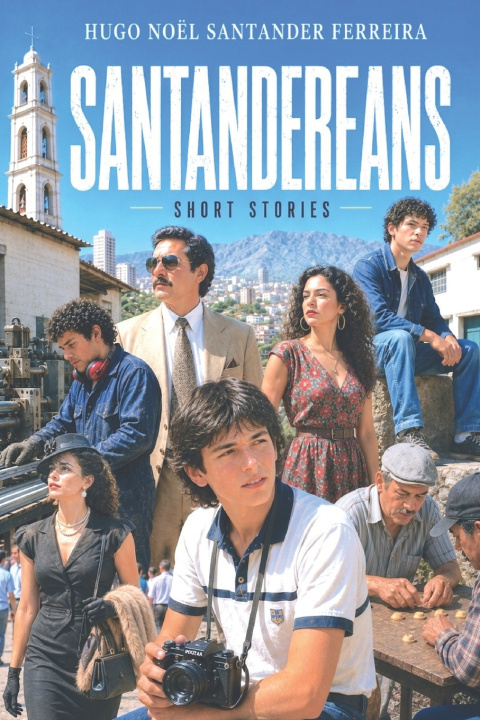
Santandereans is a cartography of power, violence, and the everyday in Santander, Colombia. The title carries a double meaning: an allusion to the people of Santander, and an allusion to the writer himself, to his way of seeing the people of his land.
In the tradition of James Joyce's Dubliners, Santander Ferreira presents a collection of interconnected stories that map the moral landscape of Santander from the late twentieth century into the early twenty-first. This is not a book about Santander in the geographic or folkloric sense. It is an exploration of behaviors: a journey through apartments, factories, schools, clubs, and barrios where the real business of the region is conducted.
Each story functions as a microsociety. A classroom becomes a laboratory of democratic simulation. A church becomes a space of transgression. An elite club becomes a theatre where politics is reduced to trading favors. A barrio becomes a field where intelligence and deceit blur together. Every character is formed under pressure: the gaze of others, economic need, the desire for recognition, the fear of punishment.
Santander Ferreira's dialogue is an instrument of power. His characters do not speak to describe the world but to position themselves within it. Every sentence is an act: an imposition, a defense, a humiliation, or a mask. Satire runs through the book as a method of knowledge, exposing our complicity with what we denounce.
At bottom, every story asks the same question: how is a subject constituted within a system where power circulates in fragments, where each person dominates another while being, in turn, dominated? Some characters ascend, others fall, others simply survive. But none remains untouched.
The collection includes "The Tower," where adolescents test their courage in Bucaramanga's tallest church; "The Nothing," where an abused boy finds his only escape in suicide; "The Chess Players," where a young chess player discovers a conspiracy; "The Judge," where a businessman confronts corruption; "Benito," where a father's fear leads to an unspeakable act; "Identity or Death," where loyalty and survival collide; "Whacks," where a card game turns into brutal revenge; and "Electoral Contest," where a school election becomes a lesson in cynicism.
Beyond the postcard idylls, Santander appears as a moral landscape where violence draws no line between social classes. The book offers no consolation and seeks none.
The earliest stories were born in the author's adolescence, when "The Tower" left his teachers perplexed and led to him being barred from the bell tower of Bucaramanga's tallest church. Fed on urban legends and court chronicles, Santander Ferreira builds an ethnographic portrait of the violence that still erodes the mythic land of El Dorado. He has spent much of his life away from his homeland, and from that distance he has built a gaze capable of revealing what proximity conceals.


Sobre o livro
Inglês
