
 Contacto
 Como comprar
Entrega
Guia de compras
Rashōmon
 Inglês
 26 b
26 b
Até 30 dias para devoluções
Os clientes também compraram












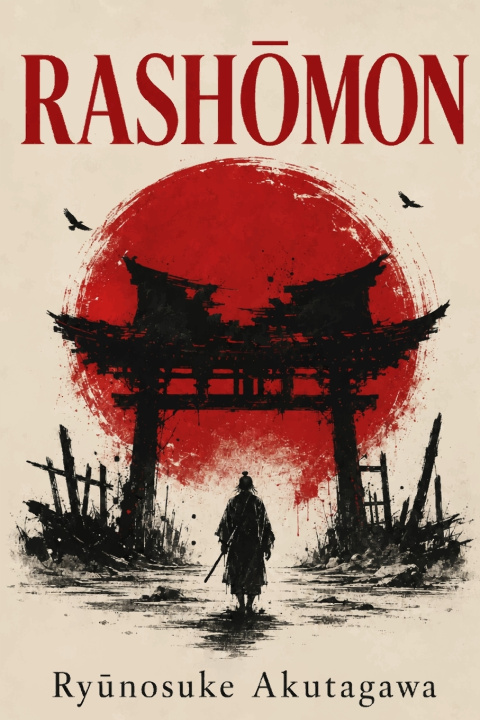
Rashōmon (羅生門) by Akutagawa Ryūnosuke, first published in 1915, is the story that launched one of the most extraordinary careers in modern Japanese literature. Akutagawa was twenty-three when he wrote it - still an undergraduate at Tokyo Imperial University - and the story is a perfect early demonstration of the method he would refine across the next twelve years of work. He took a brief, strange tale from the medieval Japanese collection Konjaku Monogatarishū, set it in the ruined Heian capital at the end of the twelfth century, and turned it into a sustained study in moral degradation.
The story is short and almost unbearably economical. A servant who has just been dismissed by his master shelters from the rain beneath the great Rashōmon gate at the southern edge of Kyoto, the gate where the dead of the famine years have been left to rot because nobody has the resources to bury them. The city around him has been destroyed by earthquakes, fires, and starvation. The servant has nowhere to go. He considers, with a strange detachment, whether he must become a thief to survive. Then he climbs into the upper storey of the gate and discovers something that changes the shape of his decision.
What follows in the closing pages of Rashōmon is one of the most controlled and disturbing endings in early twentieth-century fiction. Akutagawa never tells the reader what to think about his servant. The story simply records what happens, and lets the moral consequences accumulate. It is one of the foundational works of the modern Japanese short story, and the work that established Akutagawa's reputation when his teacher Natsume Sōseki praised it on its appearance.
A note on the famous film: Akira Kurosawa's Rashōmon (1950) takes its title and setting from this story, but its plot - the murder in the forest told from multiple contradictory perspectives - comes primarily from Akutagawa's later story In a Grove (Yabu no Naka, 1922). The two stories are often confused in English-language discussion. Rashōmon itself is the bleaker, simpler, and earlier work - a young writer's first major statement about human conduct under conditions of complete social collapse.
This edition is a new English translation by S.R. Travers, working directly from the Japanese original. The translation aims to preserve the spare control and moral coldness of Akutagawa's early prose while making the story fully available to the English-language reader.
For readers approaching Akutagawa for the first time, Rashōmon is the right place to begin - the story that announced his arrival, and that contains in compressed form the techniques he would develop across the rest of his short life. Akutagawa died in 1927 at the age of thirty-five. The Akutagawa Prize, Japan's most prestigious literary award for new writers, is named after him, and his work continues to shape Japanese fiction a century after his death.
A short, perfect early work by one of the foundational writers of modern Japanese literature, in a new English translation.
Available in Kindle and Paperback,


Sobre o livro
Inglês

Ofereça este livro hoje
É fácil
1 Adicione ao carrinho e escolha Entregar como presente ao finalizar a compra 2 Receberá um vale 3 O livro chegará ao endereço do destinatárioOlá! Sou o Libroamiko, o seu conselheiro de livros.
Como posso ajudar?