
 Contacto
 Como comprar
Entrega
Guia de compras
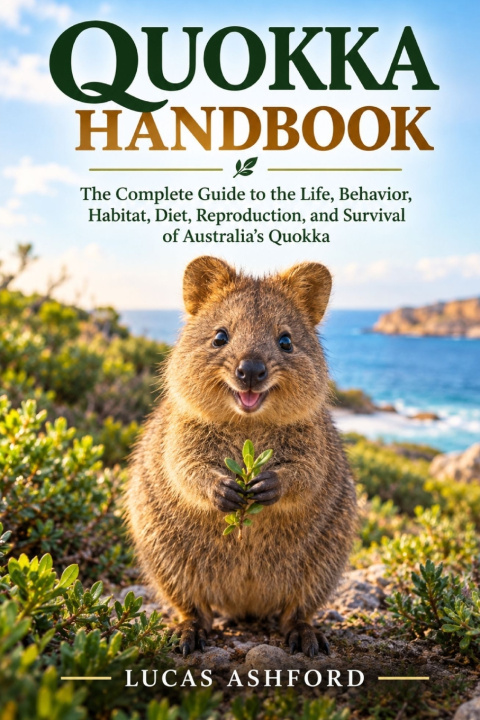
QUOKKA HANDBOOK
The Complete Guide to the Life, Behavior, Habitat, Diet, Reproduction, and Survival of Australia's Quokka
 Inglês
 41 b
41 b
 Em breve
 Novo
Novo
Até 30 dias para devoluções

The quokka is one of Australia's most distinctive and fascinating marsupials. Famous around the world for its rounded face and cheerful-looking expression, this small animal has attracted enormous public attention. Yet beyond its charming appearance lies a remarkable species with specialized adaptations, interesting reproductive biology, complex behaviors, and an important ecological role.
The Quokka Handbook has explored the species from multiple perspectives, providing a comprehensive introduction to its biology, lifestyle, habitat, and conservation.
The journey began with an introduction to the quokka, including its classification, physical characteristics, Australian origins, and distinctive appearance. As a member of the macropod family, the quokka shares important characteristics with kangaroos and wallabies while possessing its own unique body structure and lifestyle.
The handbook then examined the quokka's physical characteristics. Its compact body, strong hind legs, short tail, rounded ears, dense fur, and specialized teeth all contribute to its ability to survive in its natural environment. Its famous facial expression may attract human attention, but it is only one part of a highly adapted body.
Habitat and geographic distribution were also explored. Quokkas are native to southwestern Australia and occur on islands as well as in selected mainland areas. Their survival depends heavily on suitable vegetation, shelter, water availability, and favorable environmental conditions. Habitat protection is therefore fundamental to maintaining healthy populations.
The book also examined quokka behavior and social life. Quokkas adjust their activity according to temperature, food availability, reproductive needs, and environmental conditions. Their movement, feeding, communication, grooming, resting, and responses to danger demonstrate that they are active wild animals rather than the simple, friendly creatures sometimes portrayed in photographs.
Diet and feeding habits form another important part of the quokka's natural history. As herbivores, quokkas consume various forms of vegetation and depend on healthy plant communities for nutrition. Their feeding patterns are influenced by seasonal changes, habitat quality, and water availability. The handbook also emphasized why visitors should never feed wild quokkas human food.
The reproductive cycle of the species reveals some of its most remarkable adaptations. Female quokkas give birth to extremely underdeveloped young that continue developing within the pouch. The joey gradually grows, emerges from the pouch, begins consuming vegetation, and eventually becomes independent. Embryonic diapause adds another fascinating feature to the species' reproductive strategy.
The handbook explored the adaptations that help quokkas survive. Their powerful hind legs, compact body, protective fur, sensory abilities, herbivorous digestive system, activity patterns, and behavioral flexibility all contribute to their ability to cope with environmental challenges.
Threats and conservation were also examined in detail. Quokkas can face pressures from introduced predators, habitat loss, fragmentation, environmental extremes, disease, human disturbance, and other factors. Protecting natural habitat, managing important threats, monitoring populations, and supporting scientific research are essential elements of conservation.
The relationship between quokkas and humans was another major theme. Their popularity has created opportunities for wildlife education and tourism, particularly in areas where visitors can observe them. However, responsible behavior is essential. Quokkas should not be touched, chased, surrounded, or fed. They are wild animals and should be allowed to behave naturally.


Sobre o livro
Inglês

Ofereça este livro hoje
É fácil
1 Adicione ao carrinho e escolha Entregar como presente ao finalizar a compra 2 Receberá um vale 3 O livro chegará ao endereço do destinatárioOlá! Sou o Libroamiko, o seu conselheiro de livros.
Como posso ajudar?