
 Contacto
 Como comprar
Entrega
Guia de compras
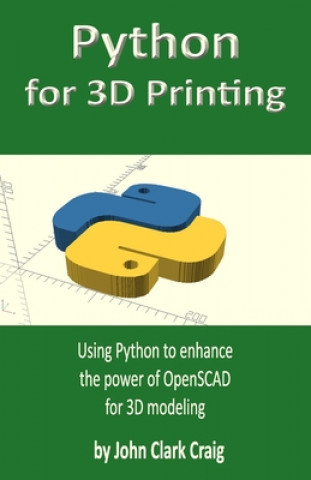
Python for 3D Printing
Using Python to enhance the power of OpenSCAD for 3D modeling
 Inglês
 55 b
55 b
Até 30 dias para devoluções
Os clientes também compraram

 /
/
 Capa mole
 13.51
€
13.51
€

 /
Capa mole
48.84
€
/
Capa mole
48.84
€





- Python for 3D Printing enables the reader to leverage the power, versatility, & simplicity of Python to enhance & super-charge the already powerful capabilities of OpenSCAD for 3D Modeling and Computer-Aided Design.
- OpenSCAD is a powerful 3D modeling language for creating 3D printed plastic parts for hobbyists and engineers.
Python is quickly becoming the world's most popular programming language, for everything from quick-and-easy hobbyist calculations to running some of the biggest online websites such as Google, YouTube, Dropbox, Reddit, etc.
Both Python & OpenSCAD are free software tools that run on Windows, Macs, and Linux machines. The symbiotic use of these two tools enables a MUCH SHORTER LEARNING CURVE than when using the expensive software packages, & it puts you in control of your designs instead of your designs controlling you!
The complete source code Python listing for driving OpenSCAD using easier-to-use commands IS INCLUDED WITH THIS BOOK, along with examples of the use of all new commands. You'll see how easy it is to integrate these two tools such that you'll see results instantly on your screen when your Python code runs.
Table of Contents - Python for 3D Printing- Introduction
- About Python
- About OpenSCAD
- OpenSCAD Limitations
- Python to the Rescue
- How Python was added to OpenSCAD
- How to Get Started
- Where to Get Python/OpenSCAD
- How to Learn from this Book
- 1 - Spheres
- 2 - Color
- 3 - Boxes
- 4 - Cylinders
- 5 - Tubes
- 6 - Cones
- 7 - Triangles
- 8 - Animation
- 9 - Polygons
- 10 - Polyhedrons
- 11 - Regular polygons
- 12 - Text
- 13 - Translate and Rotate
- 14 - Scale
- 15 - Resize
- 16 - Rotate extrude
- 17 - Spiral
- 18 - Hull
- 19 - Minkowski
- 20 - Mirror
- 21 - Projection
- 22 - Slice
- 23 - Offsets
- 24 - Difference, Union, & Intersection
- 25 - Assemblies
- 26 - Gears
- 27 - Mason bees
- 28 - Surface
- 29 - Platonic solids
OpenSCAD is a program for designing 3D parametric models for 3D printing, by creating industry standard STL files to send to 3D printers. Unlike most of the expensive software packages you may have used, it's an open source, free program, instead of costing up to thousands of dollars. Another feature is the way it works. Instead of interacting visually with a myriad of menus, sub-menus, buttons, complex settings, and parametrically driven object trees, OpenSCAD lets you drive the 3D modeling using a programming language all its own. Once the few commands are understood, many people prefer it greatly over other programs. Even though OpenSCAD is driven by text commands, the results are shown in an interactive 3D window, complete with panning, zooming, & rotating. This instant visual feedback makes creating your 3D objects a breeze.
By creating an interpretive Python syntax layer that translates to OpenSCAD, these unique issues are eliminated or minimized. You are required to learn and use only a simplified subset of standard Python syntax, which you possibly already know. Python enables more complex OpenSCAD models to be created in a shorter time because of its shorter learning curve, extendibility, flexibility, and the overriding of some limitations and quirks of OpenSCAD.
In short, the combination of Python and OpenSCAD provides a very powerful and flexible system for creating 3D models in ways neither programming language alone can provide. Here you learn a simple subset of the syntax of only one programming language, one of the most popular & powerful programming language in the world.
The OpenSCAD difference can be seen here using these examples, libraries, tutorials and OpenSCAD cheatsheets.

Sobre o livro
Inglês

Ofereça este livro hoje
É fácil
1 Adicione ao carrinho e escolha Entregar como presente ao finalizar a compra 2 Receberá um vale 3 O livro chegará ao endereço do destinatárioTambém pode estar interessado em

 /
Livro de capa dura
40.76
€
/
Livro de capa dura
40.76
€



Olá! Sou o Libroamiko, o seu conselheiro de livros.
Como posso ajudar?