
 Contacto
 Como comprar
Entrega
Guia de compras
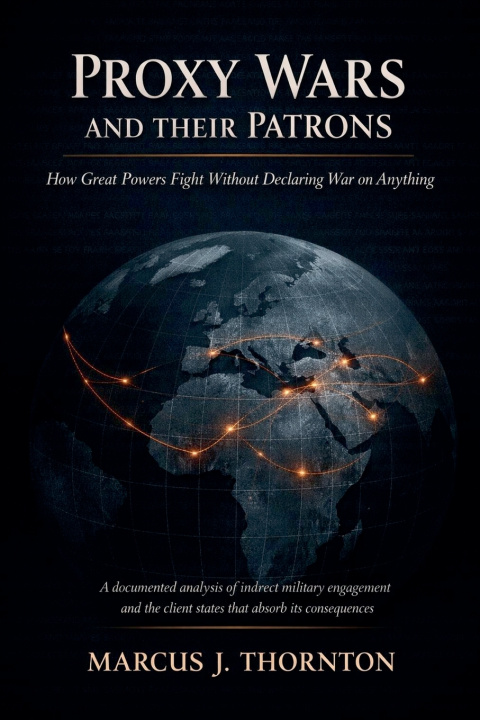
Proxy Wars and Their Patrons
How Great Powers Fight Without Declaring War on Anything
 Inglês
 97 b
97 b
 Novo
Novo
Até 30 dias para devoluções

They never declared war. They never had to.
Since 1945, the most powerful nations on earth have fought their most consequential battles through borrowed hands. The weapons were real. The dying was real. The responsibility was carefully managed from a distance.
PROXY WARS AND THEIR PATRONS is a relentlessly documented reckoning with the system that made it all possible. Drawing on declassified government archives, international court records, UN panel investigations, and the findings of organizations like Bellingcat and Conflict Armament Research, Marcus J. Thornton traces the mechanics of indirect military engagement from ancient Persia through the Cold War's killing fields to the drone supply chains of the twenty-first century.
This is not a book of theory. It is a book of specific decisions and specific consequences.
You will read how CIA funding for Afghan mujahideen, channeled through Pakistani intelligence with Saudi money, created the largest concentration of armed jihadist fighters in modern history, and what those fighters built in the decades after Washington lost interest. You will follow the weapons that left American factories licensed to Saudi Arabia and ended up over Yemeni hospitals. You will trace how Russia's Wagner Group moved through Syria, Libya, and the Sahel, signing contracts as a private security firm while pursuing objectives that could only have been set in the Kremlin.
Each case study asks the same two questions: who made the strategic decision, and who paid the human cost? The answers are never the same people.
The Cold War killed between 40 and 70 million people. Not one of those deaths occurred on American or Soviet soil. They accumulated in Korea, Vietnam, Angola, El Salvador, Nicaragua, Afghanistan, and Cambodia, in countries chosen as arenas for a competition their populations had no voice in shaping. That pattern did not end when the Berlin Wall fell. It was refined, privatized, and exported.
Thornton does not argue that great powers will stop competing. He argues that the distance between strategic decision and human consequence is a political construction, not a natural fact. It is built from secrecy, from legal frameworks that insulate patrons from accountability for what their clients do, and from media environments that bring patron-state casualties home while leaving client-state casualties as statistics.
Distance can be reduced. Accountability can be constructed. But first, the system has to be visible.
Rigorous where the record permits. Precise where it demands. Unflinching throughout.
For readers of Lawrence Wright, Dexter Filkins, and Steve Coll. For anyone who wants to understand not just that these wars happened, but why they never had to be declared.


Sobre o livro
Inglês

Ofereça este livro hoje
É fácil
1 Adicione ao carrinho e escolha Entregar como presente ao finalizar a compra 2 Receberá um vale 3 O livro chegará ao endereço do destinatárioOlá! Sou o Libroamiko, o seu conselheiro de livros.
Como posso ajudar?