
 Contacto
 Como comprar

Entrega
Guia de compras
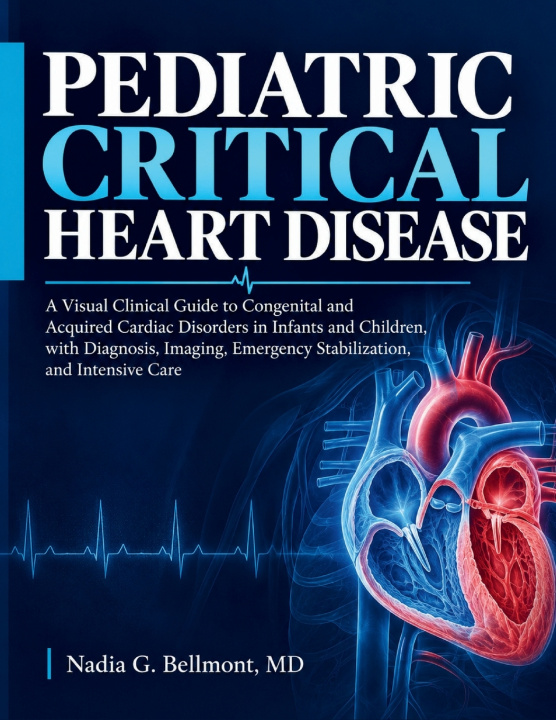
PEDIATRIC CRITICAL HEART DISEASE
A Visual Clinical Guide to Congenital and Acquired Cardiac Disorders in Infants and Children, with Diagnosis, Imaging, Emergency Stabilization, and Intensive Care
 Inglês
 489 b
 Em breve
 Novo
Até 30 dias para devoluções

When a child with heart disease deteriorates, recognizing the physiology quickly can change everything.
Pediatric Critical Heart Disease is a practical, visual, clinically focused guide designed to help readers connect cardiac anatomy, physiology, imaging, bedside findings, emergency stabilization, and intensive care into one clear framework.
Rather than treating congenital heart disease, arrhythmias, pulmonary hypertension, heart failure, and postoperative care as isolated topics, the book shows how they interact in real pediatric patients-from the newborn nursery to the cardiac intensive care unit.
WHO THIS BOOK IS FOR
Built for medical students, pediatric residents, cardiology trainees, critical-care trainees, sonographers, nurses, nurse practitioners, physician assistants, and clinicians caring for infants and children with cardiac disease, this book is structured to help you move from recognition to interpretation, and from interpretation to safe clinical action.
WHAT MAKES IT USEFUL
- A physiology-first approach that explains why a child is unstable, not just what the diagnosis is.
- Visual teaching throughout, with original diagrams covering circulation, shunts, obstruction, ECG mechanisms, pulmonary hypertension, postoperative physiology, resuscitation, mechanical support, and long-term outcomes.
- Step-by-step integration of bedside assessment, ECG, chest radiography, echocardiography, CT, MRI, and cardiac catheterization.
- Emergency-focused sections for ductal-dependent collapse, hypercyanotic spells, shunt obstruction, pulmonary hypertensive crisis, unstable arrhythmias, tamponade, shock, and pediatric cardiac arrest.
- Dedicated cardiac ICU and postoperative management guidance, including low-cardiac-output syndrome, ventilation-heart interactions, vasoactive support, bleeding, AKI, residual lesions, ECMO, and ECPR.
- Case-based clinical reasoning, review questions, quick-reference tables, emergency summaries, calculations, ECG guidance, murmur patterns, abbreviations, glossary, and congenital-lesion comparisons.
- Cardiac development, anatomy, fetal-to-neonatal transition, hemodynamics, oxygen delivery, and bedside cardiovascular assessment.
- Pediatric ECG interpretation, rhythm recognition, electrophysiology, pacemakers, ICDs, and catheter ablation.
- Left-to-right shunts, obstructive lesions, cyanotic congenital heart disease, and single-ventricle palliation from Stage I through Fontan physiology.
- Heart failure, myocarditis, cardiomyopathy, Kawasaki disease, infective endocarditis, pericardial disease, rheumatic disease, and pediatric pulmonary hypertension.
- Critical-care stabilization, postoperative management, resuscitation, ECMO, ventricular assist devices, heart transplantation, neurodevelopment, outcomes, and family-centered care.
Whether you are learning pediatric cardiology for the first time, preparing for clinical rotations and examinations, interpreting imaging, or caring for a critically ill child, this helps you see the whole clinical picture-anatomy, physiology, deterioration, stabilization, and long-term care-in one coherent reference.
Structured for professional learning, bedside reference, and rapid review.


Sobre o livro
Inglês

Ofereça este livro hoje
É fácil
1 Adicione ao carrinho e escolha Entregar como presente ao finalizar a compra 2 Receberá um vale 3 O livro chegará ao endereço do destinatárioOlá! Sou o Libroamiko, o seu conselheiro de livros.
Como posso ajudar?