Contacto
 Como comprar
Entrega
Guia de compras
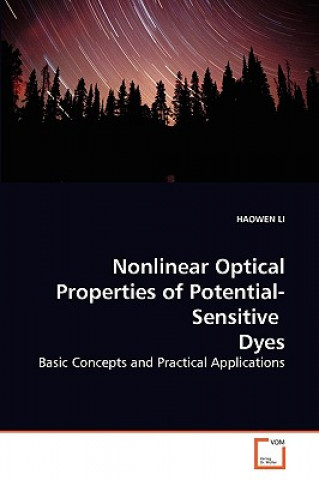
Nonlinear Optical Properties of Potential-Sensitive Dyes
Basic Concepts and Practical Applications
 Inglês
 145 b
145 b
Até 30 dias para devoluções
Os clientes também compraram




















 /
/
 Capa mole
 10.35
€
10.35
€



Potential-sensitive dyes have been extensively used to probe the electrical environment in biological membranes due to changes in its linear and nonlinear optical properties as a function of the local electric field. Ratiometric fluorescence, two-photon excited fluorescence and second harmonic generation have all been applied to study biological cell and membrane systems. Mechanism and sensitivity studies for these potential-sensitive dyes have become popular due to the increasing biological needs. In this book, fluorescence-free time-correlated single photon counting hyper Rayleigh scattering has been used to determine the hyperpolarizability of the potential-sensitive dyes. Experiment results are in agreement with quantum chemical calculations. The polarity-dependent solvent effects of linear absorption and hyper-Rayleigh scattering in solution of potential-sensitive dyes is combined together to analyze the spectral dependence of the sensitivity to the local environment. Studies of dye monolayer have been tried and high resolution fluorescence near-field scanning optical microscopic imaging with has been performed.


Sobre o livro
Inglês
Categorias

Ofereça este livro hoje
É fácil
1 Adicione ao carrinho e escolha Entregar como presente ao finalizar a compra 2 Receberá um vale 3 O livro chegará ao endereço do destinatárioTambém pode estar interessado em
 /
Capa mole
15.23
€
/
Capa mole
15.23
€



 /
Capa mole
31.78
€
/
Capa mole
31.78
€



 /
Livro de capa dura
34.63
€
/
Livro de capa dura
34.63
€