
 Contacto
 Como comprar
Entrega
Guia de compras
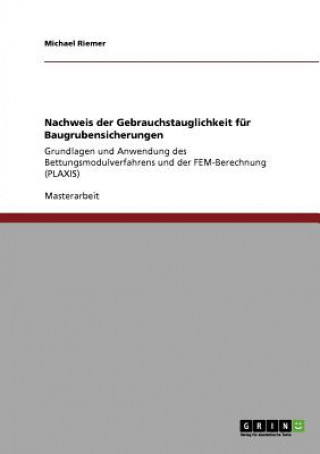
Nachweis der Gebrauchstauglichkeit für Baugrubensicherungen
Grundlagen und Anwendung des Bettungsmodulverfahrens und der FEM-Berechnung (PLAXIS)
 Alemão
 121 b
121 b
Até 30 dias para devoluções
Os clientes também compraram














 /
/
 Capa mole
 12.53
€
12.53
€

Masterarbeit aus dem Jahr 2011 im Fachbereich Ingenieurwissenschaften - Bauingenieurwesen, Note: 1,7, Hochschule für Technik, Wirtschaft und Kultur Leipzig, Sprache: Deutsch, Abstract: KurzfassungBeengte Verhältnisse in Städten, tiefe Nutzung von Grundstücken und immer größere Dimensionierung von Bauwerken machen den Einsatz von Baugrubenverbauten notwendig. Im Hinblick auf die Standsicherheit und Gebrauchstauglichkeit der Baugruben und aller benachbarten Bauwerke während aller Bauzustände haben Verformungsprognosen damit eine große Bedeutung erlangt.Für Verformungsberechnungen im Sinne des Nachweises der Gebraustauglichkeit stehen dem Geotechnikingenieur Berechnungsansätze der Stabstatik oder Numerische Verfahren zu Verfügung. Die drei gebräuchlichsten Verfahren, das klassische Trägermodell mit unnachgiebiger Stützung, das erweiterte Träger-modell mit gebettetem Wandfuß (Bettungsmodulverfahren) und die Finite-Elemente-Methode (Hardening-Soil Modell) sollen in der vorliegenden Arbeit näher erläutert und miteinander verglichen werden. Dazu werden anhand einer einfach gestützten Baugrubenwand die Berechnungsergebnisse aus ausführlichen Handrechnungen sowie den Grundbauprogrammen GGU-Retain V.5 und PLAXIS V.8 vorgestellt.Abstract The cramped situation in cities, the deep using of sites and growing up of the dimension of buildings are the reasons for necessity of deep excavations. In view for the stability and serviceability of the building pit sheeting and all adjacent constructions the importance of prediction of deformations during all building phases has increased.The Geotechnical Engineer has the choice between classical procedures or numerical methods to determine deformations for proving the Serviceability Limit State. The three common methods, the classical beam model with rigid supports, the configure beam model with earth support proposing an elastic subgrade reaction and the Finite-Elemente-Methode (using with Hardening Soil Model) should be explained and compared with each other. Therefore the results out of hand-calculations as well as of the Geotechnical design Programs GGU-Retain V.5 and PLAXIS V.8 for a single propped excavation wall are introduced.


Sobre o livro
Alemão

Ofereça este livro hoje
É fácil
1 Adicione ao carrinho e escolha Entregar como presente ao finalizar a compra 2 Receberá um vale 3 O livro chegará ao endereço do destinatárioTambém pode estar interessado em
 /
Capa mole
59.20
€
/
Capa mole
59.20
€
Olá! Sou o Libroamiko, o seu conselheiro de livros.
Como posso ajudar?