
 Contacto
 Como comprar
Entrega
Guia de compras
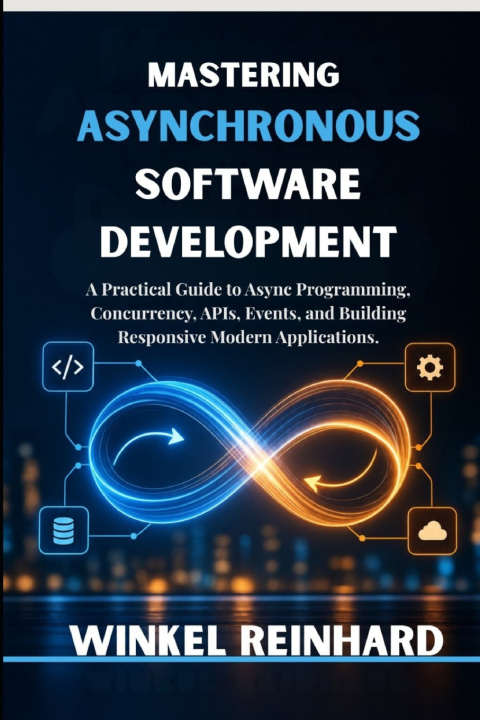
Mastering Asynchronous Software Development
A Practical Guide to Async Programming, Concurrency, APIs, Events, and Building Responsive Modern Applications.
 Inglês
 53 b
53 b
 Em breve
 Novo
Novo
Até 30 dias para devoluções

Modern software rarely operates as a simple sequence of tasks. Applications communicate with APIs, wait for databases and network services, process events, handle background jobs, and respond to multiple operations at once. As these systems become more connected and demanding, asynchronous software development becomes an essential engineering skill.
Mastering Asynchronous Software Development provides a practical and structured introduction to the principles, patterns, and techniques behind asynchronous programming, concurrency, asynchronous APIs, events, messaging, and responsive application design.
Written for developers and technical learners who want to understand asynchronous systems beyond basic definitions, this book explains the reasoning behind async design before moving into implementation. It examines how asynchronous execution works, how concurrent tasks are coordinated, how applications communicate without unnecessary blocking, and how reliable async workflows can be designed and maintained.
The focus is on practical engineering judgment: understanding when an asynchronous approach is appropriate, recognizing its trade-offs, avoiding common mistakes, and designing software that remains responsive and reliable under real-world workloads.
The book takes you from the foundations of synchronous and asynchronous execution through concurrency, non-blocking I/O, asynchronous APIs, event-driven programming, messaging, background processing, error handling, cancellation, testing, debugging, observability, and production-ready application design.
Rather than treating asynchronous programming as a collection of language features, it presents it as a way of thinking about work, execution, communication, resources, and system behavior.
What's inside:
You will explore event loops, tasks, callbacks, futures and promises, async and await, concurrency and parallelism, asynchronous I/O, API communication, polling, callbacks, webhooks, events, queues, producers and consumers, message delivery, retries, dead-letter handling, idempotency, timeouts, cancellation, failure recovery, testing, debugging, observability, performance, scalability, and common asynchronous programming anti-patterns.
The progression is designed to help you connect individual programming techniques with complete, responsive applications.
This book is suited to software developers, programmers, backend engineers, application developers, computer science learners, and technical professionals who want a stronger practical understanding of asynchronous software development.
It is especially useful for readers who understand basic programming and want to develop the skills required to work confidently with concurrent operations, APIs, events, background processing, and modern application workflows.
The value of asynchronous development is not simply about making software "faster." It is about making better use of time, resources, and system capacity while allowing applications to continue useful work instead of unnecessarily waiting for operations to complete.
By understanding asynchronous execution, you can reason more effectively about responsiveness, concurrency, resource utilization, failure handling, and the flow of work through modern software systems.
Move beyond simply knowing that asynchronous programming exists. Learn how to reason about it, implement it, test it, troubleshoot it, and apply it to practical software development.
Master asynchronous thinking. Build more responsive applications. Design software that can work effectively while other operations are still in progress.


Sobre o livro
Inglês

Ofereça este livro hoje
É fácil
1 Adicione ao carrinho e escolha Entregar como presente ao finalizar a compra 2 Receberá um vale 3 O livro chegará ao endereço do destinatárioOlá! Sou o Libroamiko, o seu conselheiro de livros.
Como posso ajudar?