
 Contacto
 Como comprar
Entrega
Guia de compras
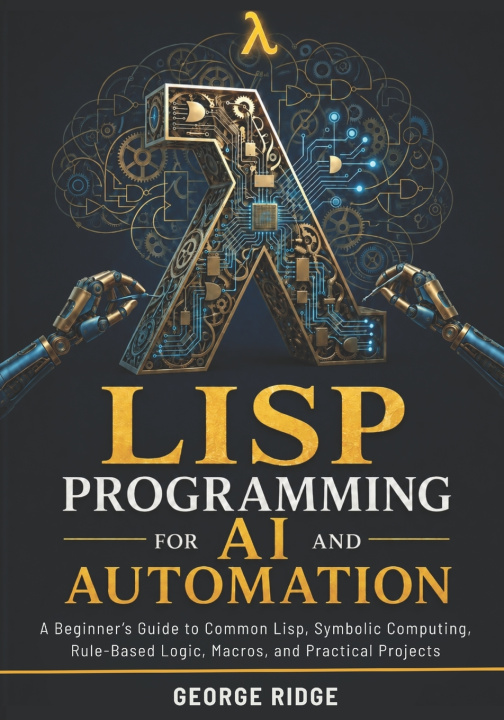
Lisp Programming for AI and Automation
A Beginner's Guide to Common Lisp, Symbolic Computing, Rule-Based Logic, Macros, and Practical Projects
 Inglês
 51 b
51 b
 Em breve
 Novo
Novo
Até 30 dias para devoluções

Common Lisp remains a powerful language for symbolic computing, rule-based logic, automation, macros, and explainable AI-style programming. While much of modern AI focuses on prediction, Lisp teaches a different and still valuable skill: representing facts, rules, workflows, decisions, and code as structured data that programs can inspect, transform, test, and extend.
Lisp Programming for AI and Automation is a practical beginner's guide to Common Lisp, written for readers who want clear foundations without heavy academic theory. It focuses on real programming workflows with SBCL, the REPL, Quicklisp, ASDF, symbolic data structures, automation scripts, rule evaluators, macros, CLOS, and small AI-style projects built around visible, traceable logic.
This book takes you from your first Lisp expressions to useful symbolic and automation-focused programs. You will learn Common Lisp syntax, functions, data structures, file handling, text processing, rule-based logic, macros, metaprogramming, object-oriented design with CLOS, and final projects that connect symbolic reasoning with practical automation workflows.
Inside you will learn how to:
- Understand Lisp, Common Lisp, symbolic computing, AI history, and practical automation use cases
- Set up a Common Lisp environment with SBCL, the REPL, Quicklisp, ASDF, and editor workflows
- Work with S-expressions, prefix notation, symbols, strings, numbers, booleans, variables, bindings, quoting, and evaluation
- Write functions, conditionals, recursion, loops, higher-order functions, and clear Common Lisp program flow
- Use lists, cons cells, sequences, arrays, vectors, hash tables, association lists, and property lists for automation data
- Build a task automation data tool for priorities, statuses, records, and simple decision support
- Read and write files, process text, create automation scripts, and generate text reports
- Represent symbolic facts, conditions, rules, and structured knowledge in readable Lisp forms
- Build a basic rule evaluator and mini expert system for explainable recommendations
- Write practical macros, inspect macro expansion, avoid macro mistakes, and create a rule definition macro
- Use CLOS with classes, objects, slots, generic functions, methods, multiple dispatch, and workflow-based program design
- Build final projects including a symbolic calculator, rule-based troubleshooting assistant, and mini DSL for automation rules
You do not need months of abstract theory to begin writing useful Lisp programs. With step-by-step explanations, compact examples, and hands-on projects, this book helps you build Common Lisp confidence while learning symbolic reasoning, rule-based systems, macros, and automation.
Get Lisp Programming for AI and Automation today and start building practical Common Lisp skills for symbolic computing, rule-based logic, automation scripts, macros, CLOS, mini expert systems, and explainable AI-style projects.


Sobre o livro
Inglês

Ofereça este livro hoje
É fácil
1 Adicione ao carrinho e escolha Entregar como presente ao finalizar a compra 2 Receberá um vale 3 O livro chegará ao endereço do destinatárioOlá! Sou o Libroamiko, o seu conselheiro de livros.
Como posso ajudar?