
 Contacto
 Como comprar

Entrega
Guia de compras
Humanity
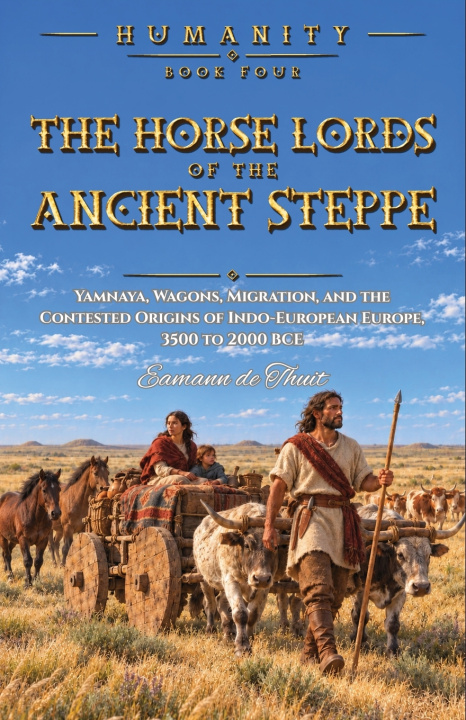
The Horse Lords of the Ancient Steppe: Yamnaya, Wagons, Migration, and the Contested Origins of Indo-European Europe, 3500 to 2000 BCE
 Inglês
 59 b
 Em breve
 Novo
Até 30 dias para devoluções

Before mounted warriors ruled the grasslands, wagons, cattle, milk, migration, and family networks were already transforming Eurasia.
Between 3500 and 2000 BCE, communities from the Black Sea to the Caspian and beyond developed new ways of living across the open steppe. They raised herds, followed seasonal pastures, travelled with heavy ox-drawn wagons, buried selected members of their communities beneath monumental mounds, and carried their ancestry and traditions across extraordinary distances.
These people are often portrayed simply as mounted conquerors. The archaeological evidence tells a more complicated and more human story.
Humanity: The Horse Lords of the Ancient Steppe explores the rise of the Yamnaya horizon and the great population movements that reshaped prehistoric Europe. It follows households rather than imaginary armies, examining how ordinary people managed animals, food, water, shelter, kinship, danger, disease, and movement across one of the world's largest grassland environments.
Inside this book, discover:
• How cattle, sheep, milk, and seasonal movement supported life on the steppe
• Why wagons changed mobility long before the age of mounted warfare
• What kurgans reveal, and what they cannot tell us, about belief, status, and community
• How ancient DNA transformed the study of Yamnaya, Corded Ware, and Bell Beaker populations
• Why migration involved families, local communities, intermarriage, conflict, and cultural exchange
• What archaeology and genetics reveal about the movement of steppe ancestry into Europe and Central Asia
• How Indo-European language theories connect with the evidence, and where uncertainty remains
• Why the familiar image of Bronze Age horse lords belongs largely to a later period
Drawing on archaeology, ancient DNA, isotope analysis, linguistics, and current scholarship, Eamann de Thuit reconstructs a world shaped by generations of movement and adaptation. The result is neither a simple invasion story nor a romantic legend of mounted warriors. It is the history of households, herds, technologies, and relationships that gradually altered the human map of Eurasia.
Richly illustrated and written for general readers, this fourth volume in the Humanity History Series continues the story begun in Humanity Before Civilization, Humanity: Sumer's Rise and Fall, and Humanity: Old Europe and the Copper Age.
The steppe changed Eurasia. The true horse age came later.


Sobre o livro
Inglês

Ofereça este livro hoje
É fácil
1 Adicione ao carrinho e escolha Entregar como presente ao finalizar a compra 2 Receberá um vale 3 O livro chegará ao endereço do destinatárioOlá! Sou o Libroamiko, o seu conselheiro de livros.
Como posso ajudar?