
 Contacto
 Como comprar
Entrega
Guia de compras
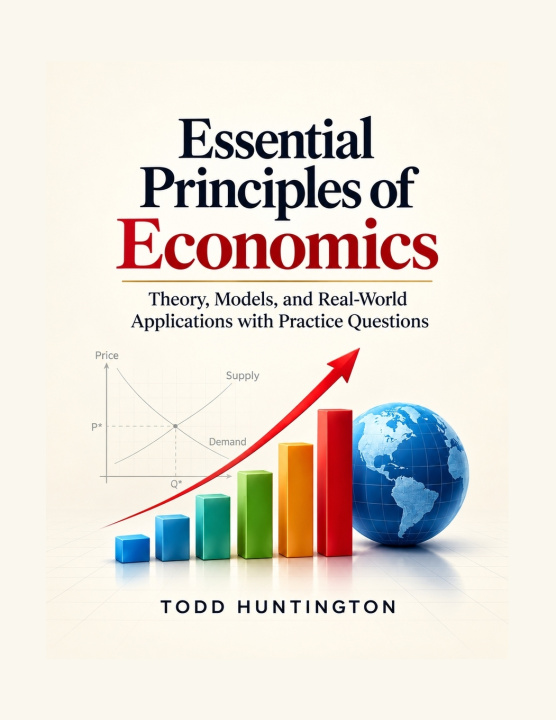
Essential Principles of Economics
Theory, Models, and Real-World Applications with Practice Questions
 Inglês
 272 b
272 b
 Novo
Novo
Até 30 dias para devoluções

Economics can feel difficult when graphs, formulas, policy debates, and real-world events are taught as separate pieces. A student may memorize the law of demand, calculate an elasticity, or define inflation and still struggle to see how the ideas connect.
Essential Principles of Economics is designed to close that gap. It presents the foundations of economic reasoning in a structured sequence that moves from scarcity, opportunity cost, incentives, and marginal thinking to markets, firms, government policy, macroeconomic performance, and the global economy. Rather than treating economics as a collection of disconnected definitions, the book shows how models are built, what assumptions they use, what they predict, and where their limits matter.
Inside, readers will learn how to:
• Interpret supply-and-demand shifts, equilibrium, price controls, and market efficiency
• Use elasticity, consumer choice, production, cost, and revenue concepts to analyze decisions
• Compare major market structures and understand competition, monopoly, oligopoly, game theory, and antitrust
• Examine labor markets, wage determination, inequality, poverty, externalities, public goods, and government intervention
• Understand GDP, inflation, unemployment, productivity, economic growth, business cycles, and aggregate demand and supply
• Follow the roles of money, banking, central banking, monetary policy, fiscal policy, government debt, exchange rates, trade, and international capital flows
The text is built for active learning. Worked examples connect equations to economic meaning, while figures and graphs help readers visualize relationships rather than merely memorize them. Each chapter includes review questions, application and critical-thinking questions, quantitative problems, multiple-choice practice, and a real-world application exercise. An answer key and solutions section, glossary, graphing and mathematics toolkit, references, and index support independent study and course use.
This book is especially suitable for college and university students taking an introductory economics course, learners who want one resource covering both microeconomics and macroeconomics, and independent readers seeking a disciplined way to interpret economic news, public policy, business decisions, and everyday trade-offs.
Open the book and begin building an integrated understanding of how economists reason, how markets and institutions interact, and how economic models can be used to analyze the choices that shape everyday life.


Sobre o livro
Inglês

Ofereça este livro hoje
É fácil
1 Adicione ao carrinho e escolha Entregar como presente ao finalizar a compra 2 Receberá um vale 3 O livro chegará ao endereço do destinatárioOlá! Sou o Libroamiko, o seu conselheiro de livros.
Como posso ajudar?