
 Contacto
 Como comprar

Entrega
Guia de compras
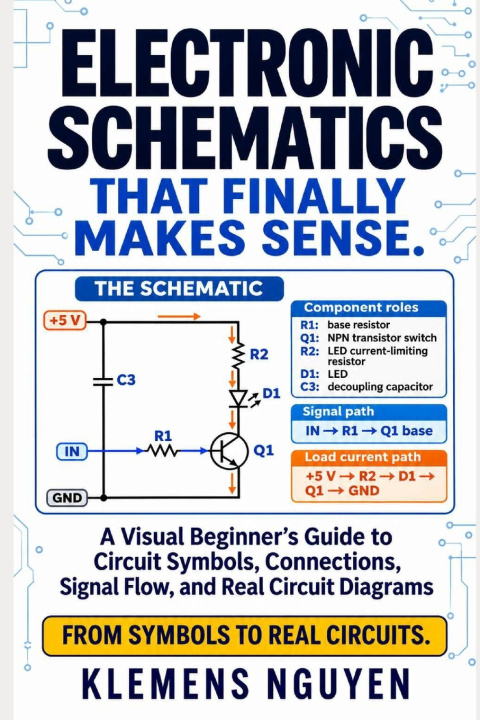
Electronic Schematics That Finally Make Sense
A Visual Beginner's Guide to Circuit Symbols, Connections, Signal Flow, and Real Circuit Diagrams
 Inglês
 48 b
 Em breve
 Novo
 Entrega de Natal ▾
Reabastecimento esperado
Lançamento 17. 11. 2026
Até 30 dias para devoluções

You Know the Symbols. But Can You Read a Real Electronic Circuit?
You recognize resistors, capacitors, diodes, and transistors. But can you look at a complete schematic, understand how it works, and find the same circuit on a real PCB?
Electronic Schematics That Finally Make Sense bridges the gap between recognizing electronic symbols and understanding real circuits.
Unlike traditional electronics textbooks focused on memorizing symbols, formulas, or designing circuits, this visual beginner's guide teaches you how to read, interpret, and verify existing electronic schematics.
What Makes This Book Different?ONE CIRCUIT. THREE VIEWS. REAL UNDERSTANDING.
See the same circuit presented as:
A schematic - Understand electrical connections, signal paths, and current flow.
Functional blocks - Discover what each component does and how the circuit works.
A real PCB - Locate physical components, identify pins, and follow visible and hidden connections.
Learn one repeatable six-step method:
Find → Divide → Trace → Explain → Match → Verify
What You'll LearnRead electronic circuit diagrams with confidence.
Identify power, ground, electrical nets, and functional blocks.
Trace signals and current paths through complete circuits.
Understand transistor switches, RC filters, op-amp feedback, logic gates, and buck converters.
Match schematic symbols to real components using datasheets, BOMs, and pinouts.
Follow PCB traces through vias, internal layers, and ground planes.
Predict circuit behavior and verify connections using practical measurements.
Approach unfamiliar schematics without guessing.
Electronics students struggling to understand complete schematics.
Hobbyists and DIY makers who want to understand how circuits work.
Beginner electronics technicians learning to trace connections and identify components.
Arduino and microcontroller enthusiasts exploring real hardware.
Self-taught learners who prefer clear illustrations and practical explanations.
Basic electronics knowledge is helpful. Advanced mathematics and circuit-design experience are not required.
From Confusing Diagrams to Real UnderstandingStart with a simple transistor-controlled LED and progress through increasingly complex circuits. Finish with a practical challenge: interpret an unfamiliar schematic, predict its behavior, and locate its components and connections on a physical PCB.
By the final chapter, you'll know how to answer three essential questions:
What is connected? How does it work? Where is it on the real board?
Stop memorizing symbols without understanding the circuit.
Get your copy today and turn confusing electronic schematics into circuits that finally make sense!


Sobre o livro
Inglês

Ofereça este livro hoje
É fácil
1 Adicione ao carrinho e escolha Entregar como presente ao finalizar a compra 2 Receberá um vale 3 O livro chegará ao endereço do destinatárioOlá! Sou o Libroamiko, o seu conselheiro de livros.
Como posso ajudar?