
 Contacto
 Como comprar
Entrega
Guia de compras
Econometric Applications of Maximum Likelihood Methods
 Inglês
 111 b
111 b
Até 30 dias para devoluções
Os clientes também compraram



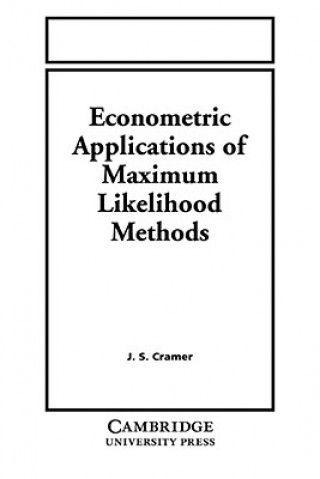
The advent of electronic computing permits the empirical analysis of economic models of far greater subtlety and rigour than before, when many interesting ideas were not followed up because the calculations involved made this impracticable. The estimation and testing of these more intricate models is usually based on the method of Maximum Likelihood, which is a well-established branch of mathematical statistics. Its use in econometrics has led to the development of a number of special techniques; the specific conditions of econometric research moreover demand certain changes in the interpretation of the basic argument. This book is a self-contained introduction to this field. It consists of three parts. The first deals with general features of Maximum Likelihood methods; the second with linear and nonlinear regression; and the third with discrete choice and related micro-economic models. Readers should already be familiar with elementary statistical theory, with applied econometric research papers, or with the literature on the mathematical basis of Maximum Likelihood theory. They can also try their hand at some advanced econometric research of their own.


Sobre o livro
Inglês

Ofereça este livro hoje
É fácil
1 Adicione ao carrinho e escolha Entregar como presente ao finalizar a compra 2 Receberá um vale 3 O livro chegará ao endereço do destinatárioOlá! Sou o Libroamiko, o seu conselheiro de livros.
Como posso ajudar?