
 Contacto
 Como comprar

Entrega
Guia de compras
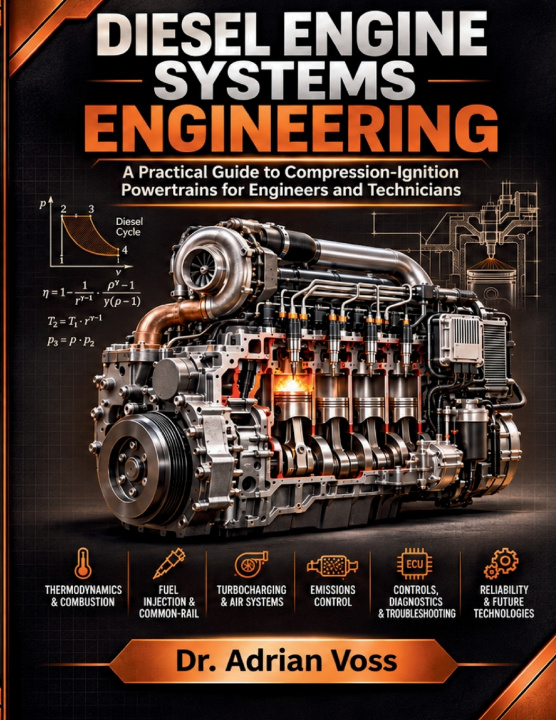
DIESEL ENGINE SYSTEMS ENGINEERING
A Practical Guide to Compression-Ignition Powertrains for Engineers and Technicians
 Inglês
 70 b
 Novo
Até 30 dias para devoluções

Two people can stand over the same heavy equipment engine and understand it in completely different ways. One can derive the heat release equation but has never heard the field vocabulary for the fault in front of them. The other can find that fault in minutes but has never worked through the physics that explains it.
That divide runs through most available material. Engineering texts develop theory without reaching a working machine. Service literature lists procedures without the reasoning behind them. Readers who need both assemble an incomplete picture from two libraries that were never written to connect, and the gap shows itself where it costs most: a power loss that could originate in four subsystems, an emissions decision with consequences three systems away, a maintenance interval chosen by habit rather than evidence.
This guide closes that gap by treating the compression-ignition engine as one integrated system, from the thermodynamics of ignition, through fuel injection, air handling, emissions control, lubrication, cooling, structure, and electronic control, to diagnosis, reliability, and life cycle decisions in the field.
Inside this book you will:
- Analyze diesel combustion stage by stage and see how ignition delay governs noise, efficiency, and emissions
- Calculate injector flow, injection duration in crank angle, compressor outlet temperature, cooler effectiveness, and volumetric efficiency
- Quantify exhaust gas recirculation, particulate filter loading, regeneration intervals, and reductant dosing from first principles
- Size bearings, oil and coolant pumps, radiators, head bolts, connecting rods, valve springs, and cam contacts against real loads
- Convert sensor readings back into physical quantities and judge whether a value is plausible for the recorded operating condition
- Trace a stored fault code to a confirmed root cause using plausibility checks, electrical testing, and ranked fault trees
- Compare maintenance strategies and replacement intervals on reliability mathematics and expected cost rather than guesswork
It is written for practicing mechanical and powertrain engineers, senior diesel and heavy equipment technicians, fleet maintenance and reliability staff, technical instructors, and upper-level engineering students. Mechanical engineering fundamentals are assumed; prior specialization in internal combustion engines is not.
Begin building the connected understanding that design work and field diagnosis both depend on, and keep a reference beside you that explains not only what to do but why it works.


Sobre o livro
Inglês

Ofereça este livro hoje
É fácil
1 Adicione ao carrinho e escolha Entregar como presente ao finalizar a compra 2 Receberá um vale 3 O livro chegará ao endereço do destinatárioOlá! Sou o Libroamiko, o seu conselheiro de livros.
Como posso ajudar?