
 Contacto
 Como comprar

Entrega
Guia de compras
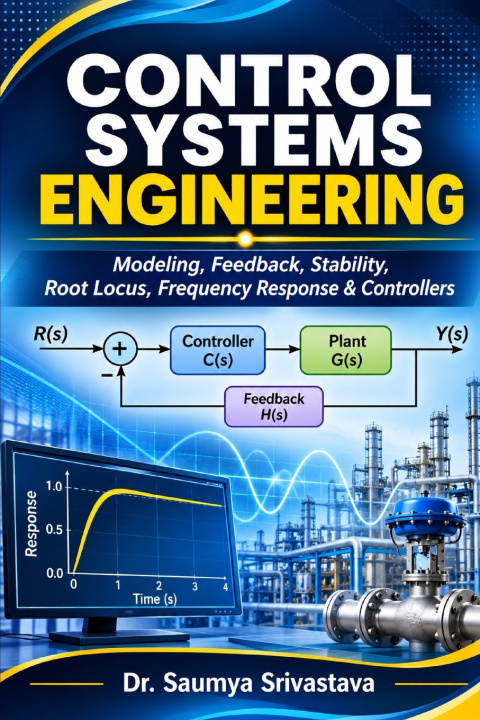
CONTROL SYSTEMS ENGINEERING
Modeling, Feedback, Stability, Root Locus, Frequency Response & Controllers
 Inglês
 43 b
 Em breve
 Novo
Até 30 dias para devoluções

Control systems engineering sits at the intersection of mathematics, physics, and practical design intuition. From the centrifugal flyball governor that regulated the speed of James Watt's steam engine to the guidance computers that land reusable rockets on autonomous drone ships, the discipline has always been about one deceptively simple idea: measuring what a system is doing, comparing it against what we want it to do, and using that difference to correct its behavior. This book is an attempt to present that idea, and the mathematics that make it rigorous and dependable, in a single coherent narrative suitable for graduate study and serious self-study.
The book is organized to follow the natural arc of a first graduate course in control systems, while going deep enough in each chapter to serve as a lasting reference. We begin with mathematical modeling of physical systems - mechanical, electrical, electromechanical, and fluidic - because a control engineer's analysis is only as good as the model beneath it. We then build the classical toolkit: block diagram algebra and signal flow graphs, time-domain performance metrics, Routh-Hurwitz stability, the root locus method, and the two complementary frequency-response pictures (Bode and Nyquist). With that toolkit in hand, we turn to design: lead, lag, and lead-lag compensation, and the PID controller family that remains the workhorse of industrial control. The second half of the book moves into state-space methods - modeling, controllability and observability, pole placement, and observer design - before closing with three subjects that distinguish a graduate treatment from an undergraduate one: digital (sampled-data) control, nonlinear control analysis, and optimal control via the linear quadratic regulator.
Every chapter follows the same internal discipline: a physical motivation, a careful derivation, a fully worked example, and a set of end-of-chapter problems. Figures and block diagrams are used liberally, because control systems is a visual subject - a well-drawn block diagram often communicates more than a page of algebra. Tables are used to consolidate design rules, transform pairs, stability criteria, and comparison summaries so that the book can also serve as a quick-reference companion once the course is complete.
This text assumes the reader has completed courses in ordinary differential equations, linear algebra, and an introductory signals-and-systems or circuits course covering the Laplace transform. Some familiarity with basic dynamics (Newton's laws, torque, and rotational inertia) is assumed for the modeling chapter. No prior exposure to control theory is assumed.
It is my hope that readers come away from this book not merely able to compute a Bode plot or place closed-loop poles, but with an intuition for why feedback works, when it can fail, and how the mathematics of stability connects to the physical behavior of the machines, vehicles, processes, and systems that increasingly run our world.


Sobre o livro
Inglês
Categorias

Ofereça este livro hoje
É fácil
1 Adicione ao carrinho e escolha Entregar como presente ao finalizar a compra 2 Receberá um vale 3 O livro chegará ao endereço do destinatárioOlá! Sou o Libroamiko, o seu conselheiro de livros.
Como posso ajudar?