
 Contacto
 Como comprar
Entrega
Guia de compras
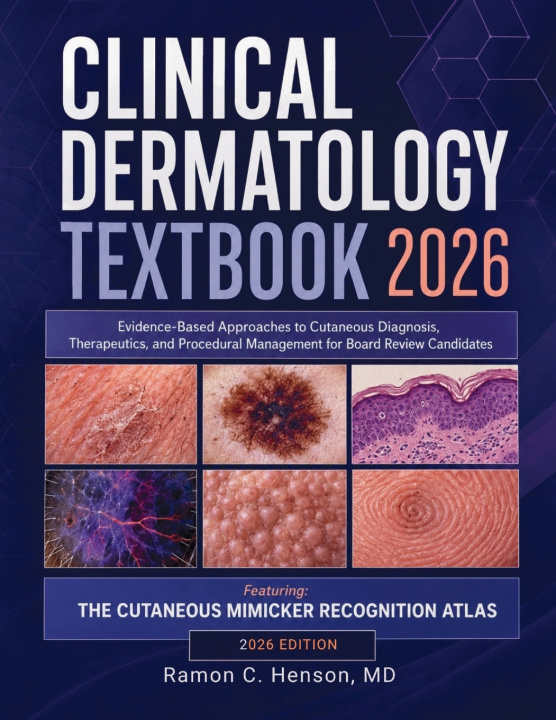
Clinical Dermatology Textbook 2026
Evidence-Based Approaches to Cutaneous Diagnosis, Therapeutics, and Procedural Management for Board Review Candidates
 Inglês
 192 b
192 b
 Novo
Novo
Até 30 dias para devoluções

Clinical Dermatology Textbook 2026 connects cutaneous structure, barrier biology, immunology, and disease mechanisms to the decisions that follow at the bedside: describe the lesion, build the differential, select the test, choose therapy, or biopsy without delay. Across 24 chapters, it moves from foundational skin science and morphology-based assessment through inflammatory, infectious, autoimmune, neoplastic, appendageal, vascular, pediatric, pigmentary, and procedural dermatology. Written for residents, medical students on rotation, primary care clinicians, and dermatology NPs and PAs, it builds board-review foundations without reducing dermatology to recall drills.
Annotated clinical, dermoscopic, histopathologic, and anatomic visuals, comparative tables, decision pathways, and integrated skin-tone considerations translate visual recognition into defensible action.
• Decode morphology, distribution, configuration, color, and surface change - turn the first examination into a focused differential.
• Select dermoscopy, KOH, Tzanck testing, Wood lamp examination, patch testing, immunofluorescence, or the correct biopsy - obtain evidence that changes management.
• Link barrier failure and Th1, Th2, and Th17 immunology to targeted treatment - understand why specific topicals, systemics, biologics, and JAK inhibitors fit particular diseases.
• Manage inflammatory and infectious dermatoses - from atopic dermatitis and psoriasis to blistering disease, viral eruptions, mycoses, and infestations.
• Recognize melanoma, non-melanoma skin cancer, and cutaneous lymphoma - distinguish benign look-alikes and act on biopsy, staging, and treatment thresholds.
• Apply Fitzpatrick IV-VI diagnostic modifiers - reduce color-dependent errors across diverse presentations.
• Use 48 Mimicker Recognition pairs and the indexed Master Atlas - identify the cognitive trap, find the Decision Anchor, and separate bedside look-alikes by morphology, site, or skin tone.
• Plan therapeutics and procedures - choose topical vehicles, systemic monitoring, phototherapy, cryotherapy, lasers, excision, grafts, and Mohs surgery with safety in view.
Open this reference before the next eruption challenges your eye, and turn pattern recognition into better dermatologic care.


Sobre o livro
Inglês
Categorias

Ofereça este livro hoje
É fácil
1 Adicione ao carrinho e escolha Entregar como presente ao finalizar a compra 2 Receberá um vale 3 O livro chegará ao endereço do destinatárioOlá! Sou o Libroamiko, o seu conselheiro de livros.
Como posso ajudar?