
 Contacto
 Como comprar
Entrega
Guia de compras
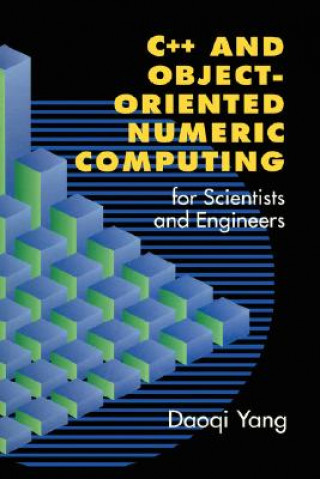
C++ and Object-Oriented Numeric Computing for Scientists and Engineers
 Inglês
 232 b
232 b
Até 30 dias para devoluções
Os clientes também compraram

 /
/
 Livro de capa dura
 26.60
€
26.60
€







 /
Capa mole
16.30
€
/
Capa mole
16.30
€

 /
Capa mole
19.00
€
/
Capa mole
19.00
€
 /
Capa mole
135.75
€
/
Capa mole
135.75
€







 /
Capa mole
17.20
€
/
Capa mole
17.20
€




 /
Capa mole
21.60
€
/
Capa mole
21.60
€



This new text/reference presents an accessible, concise, but rather complete, introduction to the C++ programming language with special emphasis on object-oriented numeric computation for scientific and engineering program development. The description of the language is in compliance with ISO/ANSI standards and is platform independent for maximum versatility. Requiring only basic calculus and linear algebra as prerequisites, the book introduces concepts, techniques, and standard libraries of C++ in a manner that is easy to understand and uses such familiar examples as vectors, matrices, integrals, and complex numbers. It also contains an introduction to C++ programs for applications with many numeric methods that are fundamental to science and engineering computing: polynomial evaluation and interpolation; numeric integration; methods for solving nonlinear equations; systems of linear equations in full, band, an d sparse matrix storage formats and ordinary and partial differential equations. Numerous techniques and examples are provided on how to reduce (C and Fortran) run-time overhead and improve program efficiency.This new text/reference presents an accessible, concise, but rather complete, introduction to the C++ programming language with special emphasis on object-oriented numeric computation for scientific and engineering program development. The description of the language is in compliance with ISO/ANSI standards and is platform independent for maximum versatility.Requiring only basic calculus and linear algebra as prerequisites, the book introduces concepts, techniques, and standard libraries of C++ in a manner that is easy to understand and uses such familiar examples as vectors, matrices, integrals, and complex numbers. It also contains an introduction to C++ programs for applications with many numeric methods that are fundamental to science and engineering computing: polynomial evaluation and interpolation; numeric integration; methods for solving nonlinear equations; systems of linear equations in full, band, and sparse matrix storage formats; and ordinary and partial differential equations. Numerous techniques and examples are provided on how to reduce (C and Fortran) run-time overhead and improve program efficiency.


Sobre o livro
Inglês
Categorias

Ofereça este livro hoje
É fácil
1 Adicione ao carrinho e escolha Entregar como presente ao finalizar a compra 2 Receberá um vale 3 O livro chegará ao endereço do destinatárioTambém pode estar interessado em

 /
Livro de capa dura
37.81
€
/
Livro de capa dura
37.81
€


 /
Capa mole
15.60
€
/
Capa mole
15.60
€

















Olá! Sou o Libroamiko, o seu conselheiro de livros.
Como posso ajudar?