
 Contacto
 Como comprar
Entrega
Guia de compras
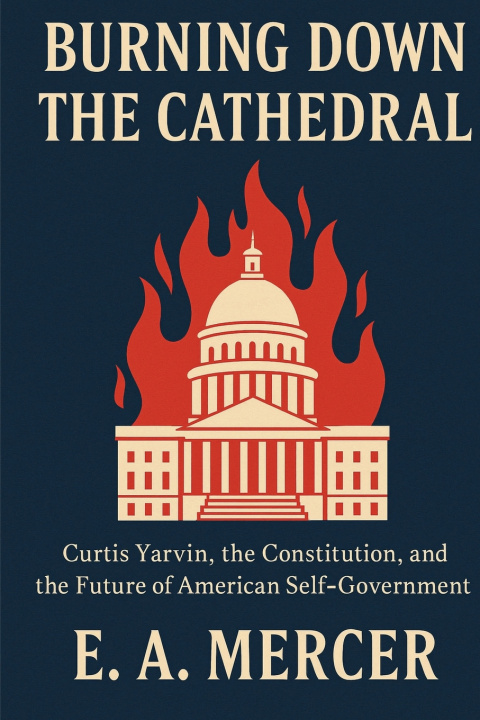
Burning Down the Cathedral
Curtis Yarvin, the Constitution, and the Future of American Self Government
 Inglês
 43 b
43 b
Até 30 dias para devoluções

Burning Down the Cathedral: Curtis Yarvin, the Constitution, and the Future of American Self-Government is a philosophical and constitutional examination of the most provocative anti-democratic thinker in contemporary American political life.
Curtis Yarvin-writing first as Mencius Moldbug and later under his own name-has spent two decades constructing an elaborate case against liberal democracy. His vision is radical: American self-government is irreparably corrupt, captured by an invisible establishment he calls the Cathedral-a hegemonic convergence of media, academia, and civil society that masks the reality of oligarchic control. His remedy is equally stark: abolish the republic, install a CEO-monarch with total executive authority, and replace democratic deliberation with corporate management. Exchange citizenship for shareholdership. Replace consent with command.
Yarvin's ideas were once confined to niche blogs. They are no longer. His framework now circulates among venture capitalists, tech founders, and the post-liberal Right. His vocabulary-formalism, neocameralism, the Cathedral, the red pill-has migrated into policy discussions, startup conferences, and the rhetoric of sitting senators.
Burning Down the Cathedral takes Yarvin seriously-and then dismantles him.
E. A. Mercer, a constitutional historian writing under the imprint of The American Respondent, approaches Yarvin as a coherent, if deeply dangerous, political philosopher whose arguments must be engaged on their own terms. The book proceeds in three parts.
Part I, The Mirror and the Machine, traces the philosophical architecture of Yarvin's worldview-from neocameralism through formalism, the Cathedral, and patch governance-showing how he fuses Enlightenment inversion with Silicon Valley accelerationism to produce a theory that strips governance of moral legitimacy and reduces citizenship to a contractual inconvenience.
Part II, The Republic Remembered, examines the mythological dimension of Yarvin's project: his red pill metaphysics, his appropriation of the Founders, and his aestheticization of autocracy. Mercer argues that Yarvin's appeal is not primarily intellectual but psychological-he offers the seduction of clarity to citizens exhausted by dysfunction. The red pill is not a revelation. It is a story-and a deeply old one.
Part III, Rewriting the Future, moves from critique to reconstruction. Mercer advances a constitutionalist alternative grounded in civic republicanism and Madisonian pluralism, proposing concrete mechanisms for renewal-from ranked-choice voting and anti-trust revival to worker ownership and a proposed Twenty-Eighth Amendment.
What Yarvin proposes is not reform. It is liquidation-the replacement of a system that honors the governed as participants with one that reduces them to subjects, and calls the reduction progress. History is not software. Democracy, for all its mess, remains the only form of government that dignifies the governed.
Burning Down the Cathedral is a defense of the republic-not as nostalgia, but as necessity.


Sobre o livro
Inglês
Categorias

Ofereça este livro hoje
É fácil
1 Adicione ao carrinho e escolha Entregar como presente ao finalizar a compra 2 Receberá um vale 3 O livro chegará ao endereço do destinatárioOlá! Sou o Libroamiko, o seu conselheiro de livros.
Como posso ajudar?