
 Contacto
 Como comprar
Entrega
Guia de compras
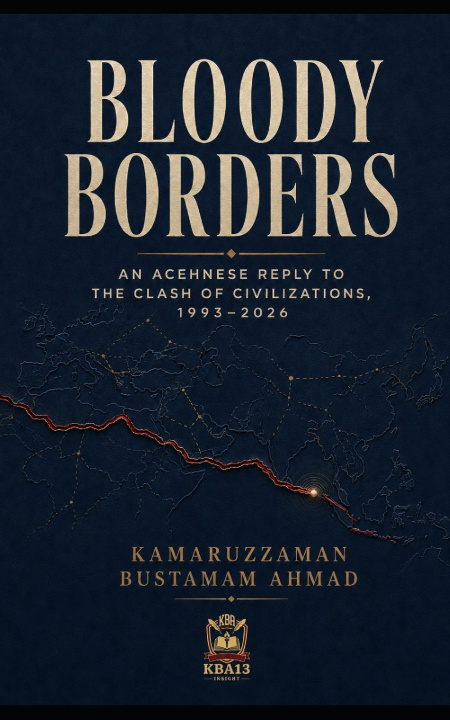
Bloody Borders
An Acehnese Reply to the Clash of Civilizations, 1993-2026
 Inglês
 69 b
69 b
 Novo
Novo
Até 30 dias para devoluções

What happens when a theory of global conflict is examined not from Washington, London, or Harvard-but from Aceh, a region that has endured colonial intervention, armed conflict, military operations, political Islam, international mediation, and an extraordinary transition to peace?
In 1993, Samuel P. Huntington proposed that the defining conflicts of the post-Cold War world would occur along the cultural and religious "fault lines" separating major civilizations. His controversial thesis became one of the most influential frameworks for interpreting relations between Islam and the West. Three decades later, its language continues to shape debates about terrorism, war, identity, migration, Western power, and the emerging multipolar world order.
Bloody Borders offers a bold Acehnese response to The Clash of Civilizations. Kamaruzzaman Bustamam Ahmad revisits Huntington's argument from the intellectual and historical perspective of Southeast Asian Islam, tracing its development from the end of the Cold War through September 11, the invasions of Afghanistan and Iraq, the War on Terror, the rise of Islamophobia, and the geopolitical transformations of the twenty-first century.
Rather than treating civilizations as fixed and naturally hostile entities, the book investigates how political power, military strategy, media narratives, economic interests, and the production of enemies can turn cultural differences into violent boundaries.
Aceh provides the book's distinctive vantage point. Its experience of war, identity, natural resources, state power, foreign involvement, and international peacebuilding reveals how grand geopolitical theories are ultimately lived by ordinary people. From this peripheral yet strategically significant region, the author asks whether civilizations truly clash-or whether political actors construct civilizational divisions to legitimize domination and conflict.
Combining political anthropology, Islamic studies, international relations, intellectual history, and geopolitical analysis, Bloody Borders examines:
- Samuel Huntington and the intellectual origins of the clash-of-civilizations thesis
- Islam-West relations after the Cold War
- September 11, Afghanistan, Iraq, and the global War on Terror
- Western hegemony and the politics of describing Islam
- Orientalism, Islamophobia, terrorism, and civilizational identity
- Aceh's conflict and peace process within global politics
- American power and the changing international order
- The rise of China, BRICS, and the multipolar world
- The continuing relevance-and limitations-of Huntington's thesis in 2026
Provocative, historically grounded, and intellectually independent, Bloody Borders is not merely a critique of Huntington. It is an intervention from the Global South: a call to reconsider who defines civilization, who draws its borders, and who pays the price when those borders are made to bleed.
An essential book for readers of geopolitics, international relations, Islam and the West, political anthropology, religious conflict, Southeast Asian studies, Aceh studies, American foreign policy, terrorism studies, and the changing world order.


Sobre o livro
Inglês
