
 Contacto
 Como comprar

Entrega
Guia de compras
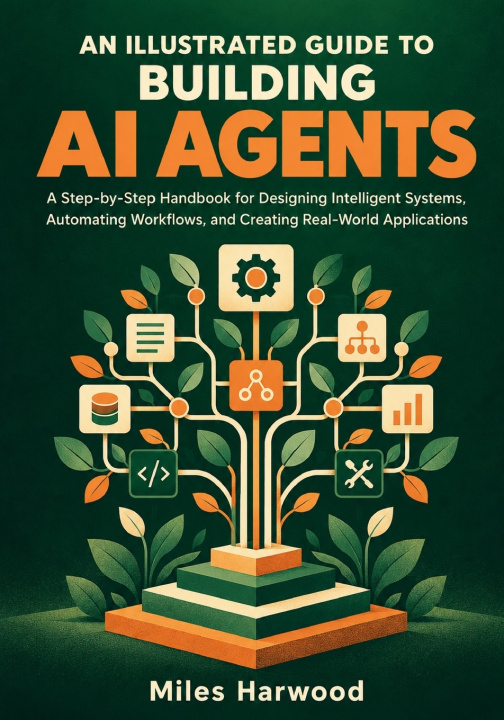
AN ILLUSTRATED GUIDE TO BUILDING AI AGENTS
A Step-by-Step Handbook for Designing Intelligent Systems, Automating Workflows, and Creating Real-World Applications
 Inglês
 48 b
 Novo
Até 30 dias para devoluções

What separates a useful AI agent from a demo that only appears to work? Clear goals, controlled tools, reliable checks, and a system that knows when to stop.
Building an agent means more than writing a prompt. Once software can retrieve information, select actions, use external services, or coordinate several steps, developers must manage permissions, state, cost, uncertainty, and failure. A fluent model response is not proof that a task was completed correctly.
This illustrated, step-by-step handbook shows how to approach those challenges through practical agent engineering. Starting with the foundations of language models and agent architecture, it develops the components of bounded applications and explores how they fit into dependable workflows.
Inside, you will learn to define agent goals and enforceable constraints; set up a reproducible Python environment; design prompts and structured outputs; validate tool and API calls; and manage context, memory, and retrieval-augmented generation.
You will also examine planning and replanning, collaboration between specialist agents, deterministic workflow controls, approval checkpoints, and safe recovery when an operation fails. Worked examples show why implementation details such as schema validation, iteration limits, and observable results matter.
Illustrated architecture diagrams explain the flow of information and authority. Practice problems and answer explanations reinforce the lessons. Later chapters address testing, evaluation datasets, tracing, regression checks, security, prompt injection, least-privilege permissions, deployment, monitoring, and operating costs. The book concludes with an integrated application and practical reference material.
Designed for developers, technically inclined learners, and practitioners with basic Python knowledge, this guide assumes no advanced machine-learning mathematics. Its emphasis is not unrestricted autonomy or guaranteed performance, but informed design choices and evidence-based testing.
Get your copy and begin building a sound engineering foundation for AI agents, from the first controlled decision loop to the requirements of a real-world application.


Sobre o livro
Inglês

Ofereça este livro hoje
É fácil
1 Adicione ao carrinho e escolha Entregar como presente ao finalizar a compra 2 Receberá um vale 3 O livro chegará ao endereço do destinatárioOlá! Sou o Libroamiko, o seu conselheiro de livros.
Como posso ajudar?