
 Contacto
 Como comprar
Entrega
Guia de compras
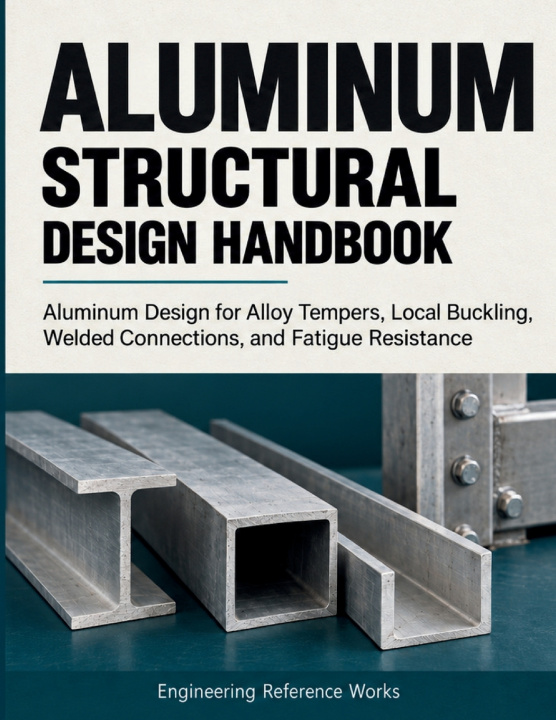
ALUMINUM STRUCTURAL DESIGN HANDBOOK
Aluminum Design for Alloy Tempers, Local Buckling, Welded Connections, and Fatigue Resistance
 Inglês
 317 b
317 b
 Em breve
 Novo
Novo
Até 30 dias para devoluções

Aluminum is not steel, and designing it as if it were is where most aluminum structural problems begin.
Structural engineers are trained on steel. When an aluminum roof, canopy, curtain wall, marine deck, bridge deck, or transit structure lands on the desk, the familiar intuition quietly fails: the modulus is about one-third of steel's, so deflection and buckling govern long before yield; welding a heat-treated alloy can strip more than half of its strength in the heat-affected zone; the material has no true fatigue endurance limit; and the thin walls that make extrusions efficient buckle locally at stresses well below yield. The governing aluminum specification is dense, costly, and assumes you already understand why each provision exists. Few current references bridge that gap for a working engineer.
This handbook was written to close it. A complete, self-contained reference for aluminum members and connections, it follows the chapter logic of the governing specification and develops each topic from first principles through fully worked numerical examples under both the allowable strength design and load and resistance factor design methods. Every variable and unit is defined where it appears, every example is carried to a boxed final answer, and no chapter sends you elsewhere for an equation.
What this handbook helps you do
- Read any wrought or cast alloy-temper designation and predict how the product will behave when welded, formed, heated, or exposed to a corrosive environment.
- Assemble consistent design values, including welded strengths and the buckling constants that govern every compression and flexural limit state.
- Design tension members, columns, beams, and members under combined forces, recognizing when yielding, rupture, local buckling, lateral-torsional buckling, or serviceability actually governs.
- Size bolted, screwed, pinned, and welded connections while accounting for galvanic compatibility, block shear, prying action, and weld placement.
- Evaluate fatigue using stress range, detail categories, and cumulative damage, and understand why detail geometry matters more than alloy strength.
- Detail for deflection, vibration, thermal movement, corrosion, fabrication tolerance, and erection stability so the structure performs in service as it did on paper.
Key topics covered
Alloy and temper designation systems; stress-strain behavior and buckling constants; ASD and LRFD philosophy and load combinations; axial tension and net-section rupture; column and local buckling; flexure, lateral-torsional buckling, shear, and torsion; web crippling and bearing stiffeners; mechanically fastened and welded connections; fatigue; serviceability and vibration; corrosion and protective design; fabrication, erection, testing, and quality assurance, supported by dozens of worked examples, over 130 practice problems with answers, a glossary, unit conversions, quick-reference tables, and an index.
Who this book is for
Practicing structural, civil, marine, and mechanical engineers moving from steel to aluminum; engineers of record reviewing curtain walls, canopies, railings, decks, towers, and transportation structures; exam candidates and graduate students who need worked calculations rather than theory alone; and fabricators and specialty engineers who must understand why a tolerance, weld location, or alloy choice matters.
Stop designing aluminum by analogy.
Open this handbook and begin working through the buckling, welding, and fatigue behavior that actually governs aluminum structures, one worked example at a time.


Sobre o livro
Inglês

Ofereça este livro hoje
É fácil
1 Adicione ao carrinho e escolha Entregar como presente ao finalizar a compra 2 Receberá um vale 3 O livro chegará ao endereço do destinatárioOlá! Sou o Libroamiko, o seu conselheiro de livros.
Como posso ajudar?