
 Contacto
 Como comprar

Entrega
Guia de compras
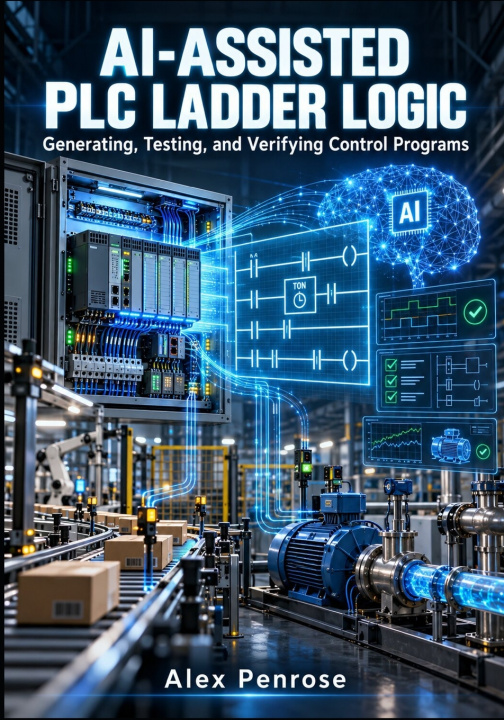
AI-ASSISTED PLC LADDER LOGIC Generating, Testing, and Verifying Control Programs
Draft Rungs with LLMs, Validate in OpenPLC, Check Interlocks, and Document IEC 61131-3 Logic
 Inglês
 106 b
 Em breve
 Novo
Até 30 dias para devoluções

Learn to generate PLC ladder logic with AI, test its behavior, detect hidden errors, and verify control programs before they reach real equipment.
AI can draft PLC programs in seconds, but can you trust the logic it produces? Incorrect interlocks, missed sensor transitions, timer errors, and unexpected restarts can turn seemingly correct code into unreliable control behavior.
AI-Assisted PLC Ladder Logic gives you a practical engineering workflow for turning control requirements into structured, testable programs. Using OpenPLC, Structured Text, Python, and formal verification techniques, you will learn how to review AI-generated logic, validate its execution, and document the evidence behind your decisions.
Designed for automation engineers, controls technicians, engineering students, and software developers entering industrial automation, this guide combines essential PLC fundamentals with realistic control applications and verification methods.
What You Will Learn:
- Understand PLC programming fundamentals: Read ladder diagrams, work with IEC 61131-3 languages, and understand scan cycles, execution order, data types, and retained memory.
- Build and simulate programs in OpenPLC: Configure the Editor and runtime, create programs and function blocks, compile logic, monitor variables, and troubleshoot execution.
- Generate better ladder logic with LLMs: Convert functional specifications into precise AI prompts, Boolean expressions, ladder rungs, and Structured Text while identifying unsupported instructions and logic errors.
- Develop reliable control functions: Implement motor start-stop circuits, seal-in logic, edge detection, TON, TOF, and TP timers, counters, analog thresholds, hysteresis, and controlled restart sequences.
- Design interlocks and fault recovery: Build operating permissives, manual-automatic modes, state machines, equipment feedback monitoring, alarms, and recovery logic.
- Test beyond normal operation: Create truth tables, automated Python tests, fault-injection scenarios, regression tests, and closed-loop process simulations that reveal timing and sequence defects.
- Apply formal verification techniques: Export PLCopen XML, define invariants and mutual-exclusion properties, use ESBMC for bounded verification, and investigate counterexamples and modeling limitations.
- Develop practical industrial applications: Work through motor controllers, two-conveyor transfer systems with jam detection, tank filling with lead-lag pump control, and batch packaging sequences.
- Integrate and protect control systems: Understand Modbus TCP, register mapping, signal scaling, remote I/O polling, stale data, reusable libraries, and PLC runtime security.
- Document and verify engineering changes: Manage source revisions, requirements traceability, automated test evidence, FAT and SAT records, and final engineering reports.
Practical learning resources included: Numbered code listings, chapter summaries, tool setup instructions, a quick-reference appendix covering PLC instructions and development commands, a technical glossary, and an index for finding important concepts.
Learn through code: Follow Ladder Diagram illustrations, Structured Text function blocks, Python testing scripts, and configuration examples to develop, analyze, and evaluate simulated industrial control applications.
Whether you are building your first AI-assisted PLC workflow or strengthening your existing verification practices, this book helps you move from generated code to control logic supported by clear requirements and meaningful testing.
Get your copy today and develop a more disciplined approach to AI-assisted PLC programming, testing, and verification.


Sobre o livro
Inglês

Ofereça este livro hoje
É fácil
1 Adicione ao carrinho e escolha Entregar como presente ao finalizar a compra 2 Receberá um vale 3 O livro chegará ao endereço do destinatárioOlá! Sou o Libroamiko, o seu conselheiro de livros.
Como posso ajudar?