
 Contacto
 Como comprar
Entrega
Guia de compras
 Inglês
 50 b
50 b
 Em breve
 Novo
Novo
Até 30 dias para devoluções

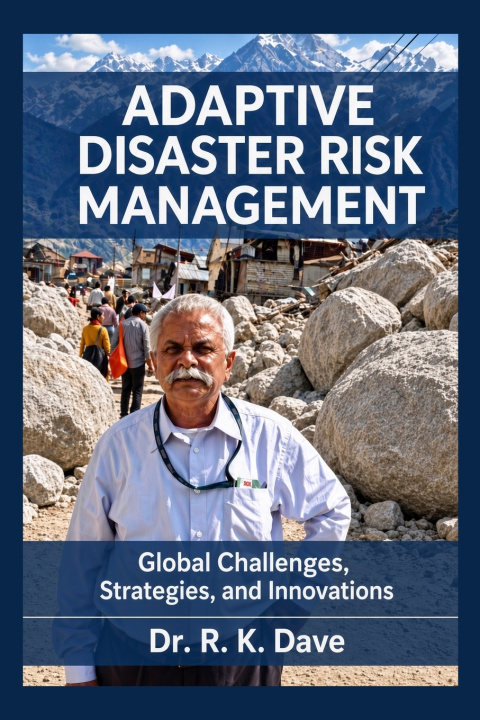
Adaptive Disaster Risk Management: Global Challenges, Strategies, and Innovations
Disaster risk today is shaped as much by institutions, infrastructure, and global interdependence as by hazards themselves. Climate change, rapid urbanization, technological linkage, and geopolitical disruption are changing risk faster than traditional, reactive, project-driven systems can manage. This book argues for disaster risk management that can learn, adjust, and keep working under uncertainty, constraint, and fragmentation.
Adaptive is the central idea. Adaptive systems evolve as risks, technologies, and institutions change. They start from real capacities rather than imported blueprints. They combine scientific and Indigenous knowledge. They last because countries own and finance them. And they keep operating when international cooperation weakens. Resilience is therefore not only technical. It is institutional, commercial, and societal.
Modern disasters cross agencies, borders, and the public-private divide. Floods, wildfires, cyberattacks, pandemics, and infrastructure failures cascade through systems whose dependencies are invisible in ordinary times. Resilience depends on whether governments, private operators, communities, and partners can keep essential services running and adapt when supply chains, finance, or cooperation break.
Lifeline systems-energy and fuel, water, health and pharmaceuticals, food, communications, and transport-are the backbone of social continuity and economic exchange. Most are privately operated, so public-private partnership is not an add-on; it is core. Durable partnerships align governments, investors, operators, manufacturers, logistics firms, insurers, and communities so capital, technology, expertise, and services can move quickly when disaster strikes.
Resilience cannot be imported as a finished product. Capabilities built with external funding decay when projects end unless ownership, financing, maintenance, procurement, and skills are built at the same time. Sustainable resilience means institutions that can operate, pay for, maintain, understand, and adapt solutions in their own setting, backed by trusted regional and international partners.
Early warning remains essential, but only inside the full continuum: risk knowledge, prevention and mitigation, preparedness, response, and recovery. A warning matters only at the last mile-when people receive it, trust it, understand it, and have authority and resources to act. Adaptive management therefore brings local government, communities, business, and Indigenous knowledge into the system.
In a fragmenting world of strained alliances, disrupted trade, and sanctions, resilient domestic systems and reliable partnerships matter more, not less. Trade and investment, supported by capable institutions and mutual interest, remain practical channels for resilience even when politics does not.
The book gives practitioners, policymakers, managers, and private-sector leaders a framework for diagnosing systemic weakness and designing capacity-sensitive strategies that fit different national realities. Its purpose is to strengthen institutions, guide investment, build lasting public-private partnerships, and connect local resilience to the trade and economic networks on which modern societies depend.


Sobre o livro
Inglês
Categorias

Ofereça este livro hoje
É fácil
1 Adicione ao carrinho e escolha Entregar como presente ao finalizar a compra 2 Receberá um vale 3 O livro chegará ao endereço do destinatárioOlá! Sou o Libroamiko, o seu conselheiro de livros.
Como posso ajudar?