
 Contacto
 Como comprar
Entrega
Guia de compras
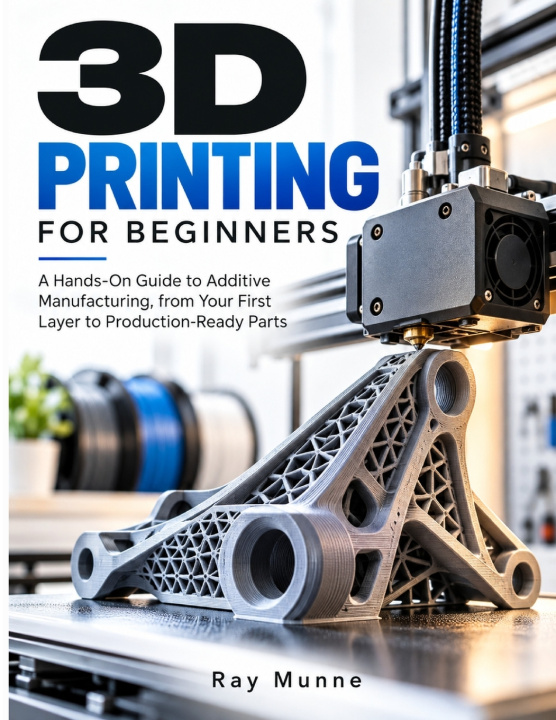
3D PRINTING FOR BEGINNERS
A Hands-On Guide to Additive Manufacturing, from Your First Layer to Production-Ready Parts
 Inglês
 182 b
182 b
 Novo
Novo
Até 30 dias para devoluções

A failed print tells you that something is wrong. It does not tell you what.
Most introductions to 3D printing answer that question with a list: match the symptom to the picture, apply the fix, hope it works. It works often enough to feel like teaching, and fails the moment you meet a symptom nobody has catalogued.
There is a quieter problem. Several numbers repeated across beginner material do not survive a check against manufacturers' published data - that overhangs fail beyond forty-five degrees, that desktop machines hold a tenth of a millimetre, that powder processes give isotropic parts. Design around them and you will make parts that do not fit or do not hold.
This book takes the opposite approach, building the subject from its physics outward, so the reasoning transfers to machines, materials and failures it never mentions. Material is added in layers. Each layer must bond to the one beneath. A cooling part contracts. Almost everything that looks like arcane craft knowledge follows from facts of that kind, and this book derives it rather than asking you to memorise it.
Working through it, you will be able to:
- Trace a design from solid model to build file, and account for every stage at which accuracy is lost.
- Read a technical data sheet critically, and choose a feedstock against a stated service requirement.
- Determine the critical overhang angle for your own machine and settings, and decide when support is needed.
- Predict where a part will fail under load, and choose build orientation from the load path rather than from habit.
- Calibrate in the correct dependency order, and work from symptom to cause instead of changing four things at once.
- Estimate build time, material and unit cost - and recognise when this technology is the wrong choice.
Written for the hobbyist whose prints keep failing, the student meeting the subject formally, the maker moving towards parts that must work, and the designer or engineer who needs dependable working knowledge.
Start with the first layer. Open the book, work the procedures in order, and build the understanding that lets you diagnose a problem nobody has written down. Then keep it beside the machine, where the tables and troubleshooting matrix do the daily work. Add this guide to your library and begin.
Please note. This book is educational. The processes it describes involve real hazards, including hot surfaces, skin-sensitising resins, fine powders and flammable solvents. Its safety guidance is general and does not replace the safety data sheet supplied with any material, the instructions supplied with any machine, or local regulations. Nothing in it qualifies a reader to produce parts for load-bearing, safety-critical, medical, aerospace, automotive or regulated use. Figures were checked against published data at the time of writing; materials are reformulated, so confirm any figure against the current data sheet.


Sobre o livro
Inglês

Ofereça este livro hoje
É fácil
1 Adicione ao carrinho e escolha Entregar como presente ao finalizar a compra 2 Receberá um vale 3 O livro chegará ao endereço do destinatárioOlá! Sou o Libroamiko, o seu conselheiro de livros.
Como posso ajudar?