
 Contacto
 Como comprar
Entrega
Guia de compras
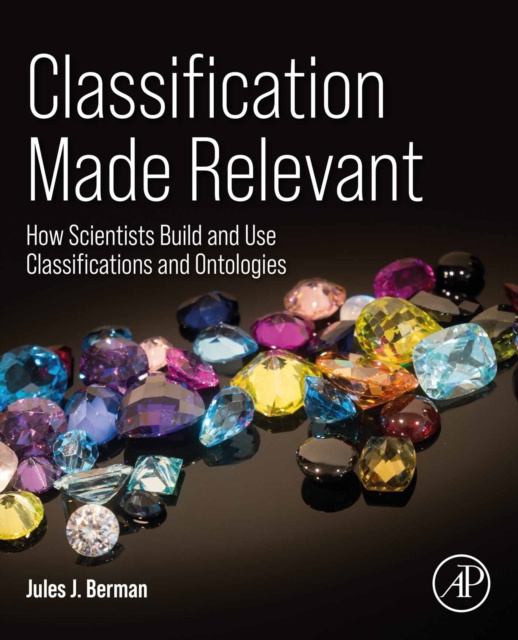
Classification Made Relevant
How Scientists Build and Use Classifications and Ontologies
 Inglês
 295 b
295 b
Também pode estar interessado em




 /
/
 Livro de capa dura
 45.70
€
45.70
€

Classification Made Relevant explains how classifications and ontologies are designed, and how they are used to analyze scientific information. It is through our description of the relationships among classes of objects that we are able to simplify knowledge and explore the ways in which individual classified objects behave. The book begins by describing the fundamentals of classification and leads up to a description of how computer scientists use object-oriented programming languages to model classifications and ontologies. Numerous examples are chosen from the Classification of Life, the Periodic Table of the Elements, and the symmetry relationships contained within the Classification Theorem of Finite Simple Groups. When these three classifications are tied together, they provide a relational hierarchy connecting all of the natural sciences. This book is intended to reach a multidisciplinary audience of students and professionals working in the data sciences, the library sciences, and all of the STEM sciences. The chapters introduce and describe general concepts that can be understood by any intelligent reader. With each new concept, there follow practical examples selected from various scientific disciplines. In these cases, technical points and specialized vocabulary are linked to glossary items, where the item is clarified and expanded. Technical terms in the data sciences often have different meanings, depending on the reader's specific discipline. The word "e;ontology has so many meanings, it has become meaningless. Skeptics can google on the word "e;ontology to quickly confirm the inchoate status of this subject. In such cases, the glossary describes the different way the term has been used and will clarify its meaning within the book's context. For the benefit of computer scientists, the glossary contains short scripts written in Perl or Python or Ruby. Non-programmers will be spared from reading computer code, without missing out on the concepts covered in each chapter. By using the glossary links, every reader experiences a version of this book tailored to their personal needs and preferences. Explains the theory and the practice of classification. Emphasizes the importance of classifications and ontologies to the modern fields of mathematics, physics, chemistry, biology, and medicine. Includes numerous real-world examples demonstrating how bad construction technique can destroy the value of classifications and ontologies Explains how we define and understand the relationships among the classes within a classification, and how the properties of a class are inherited by its subclasses. Describes ontologies, and how they differ from classifications. Explains those conditions under which ontologies are useful. Explains how statements of meaning are properly expressed as triples. Shows how triples can be specified by popular semantic languages. Explains how triplestores (large collections of triples) can be usefully linked to classifications and ontologies. Demonstrates how classifications, ontologies, and triplestores are modeled by modern object-oriented languages.


Sobre o livro
Inglês

Ofereça este livro hoje
É fácil
1 Adicione ao carrinho e escolha Entregar como presente ao finalizar a compra 2 Receberá um vale 3 O livro chegará ao endereço do destinatárioOlá! Sou o Libroamiko, o seu conselheiro de livros.
Como posso ajudar?